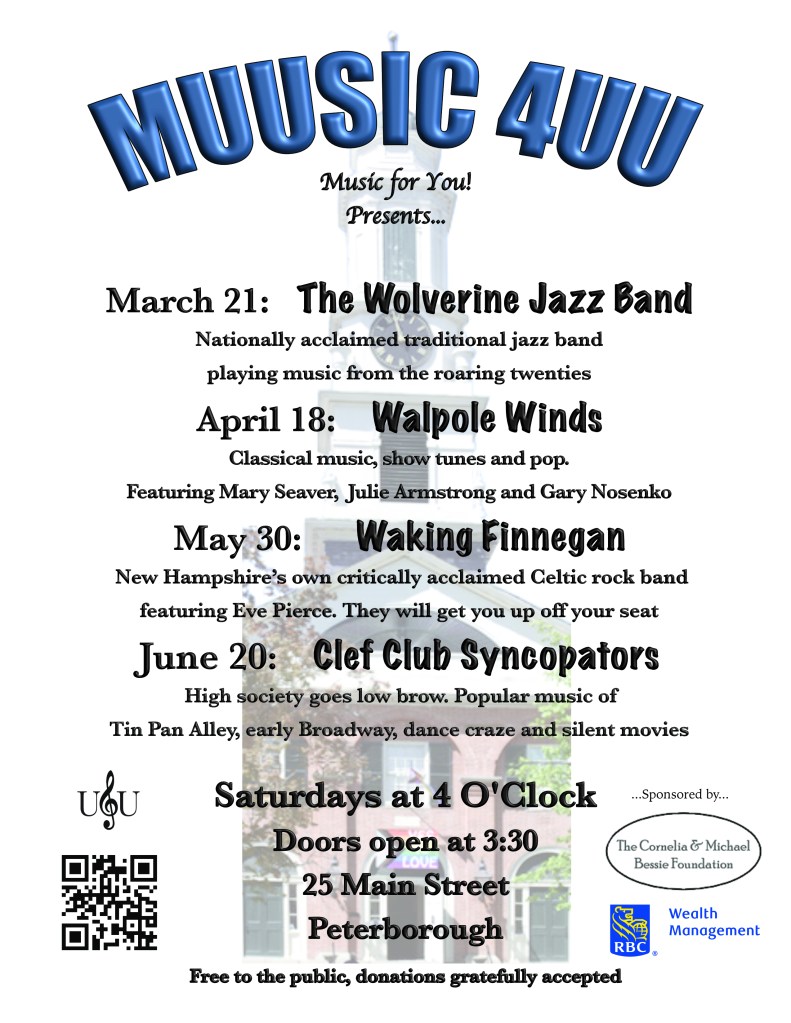
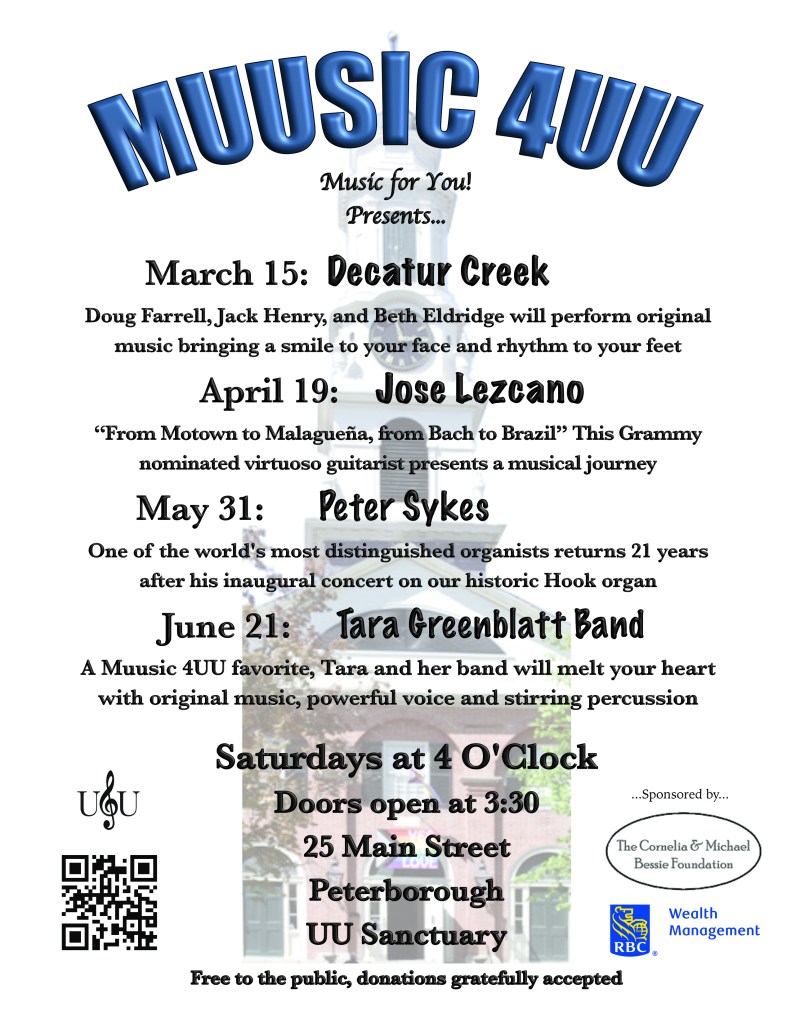
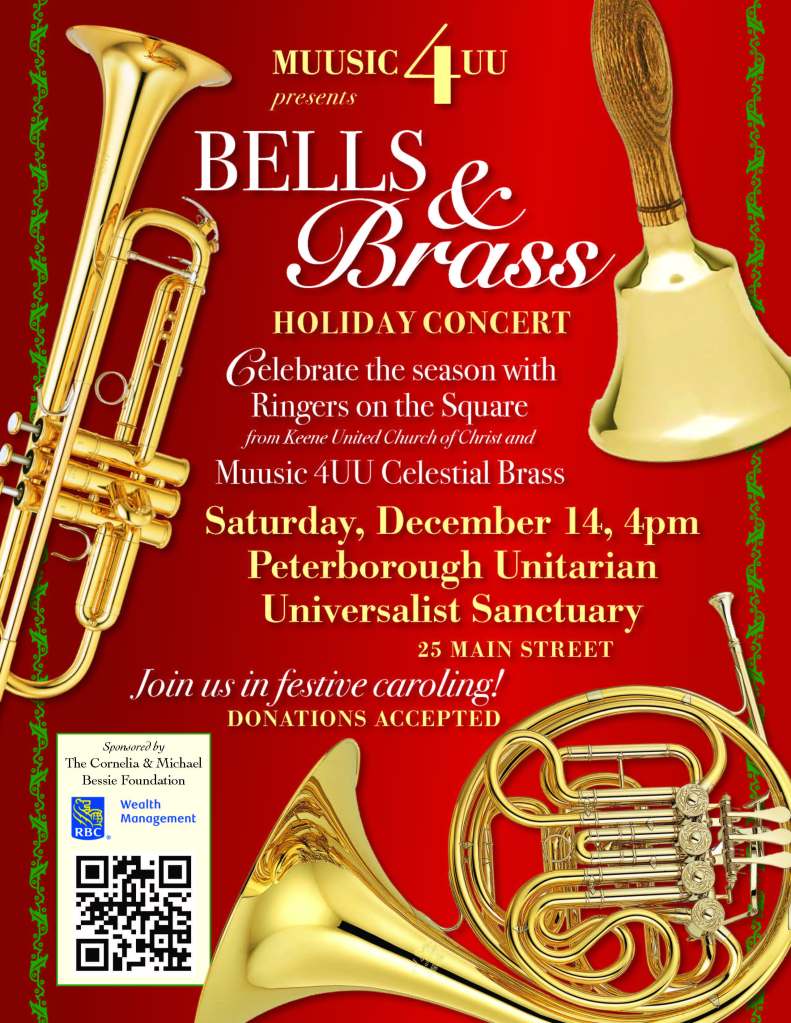
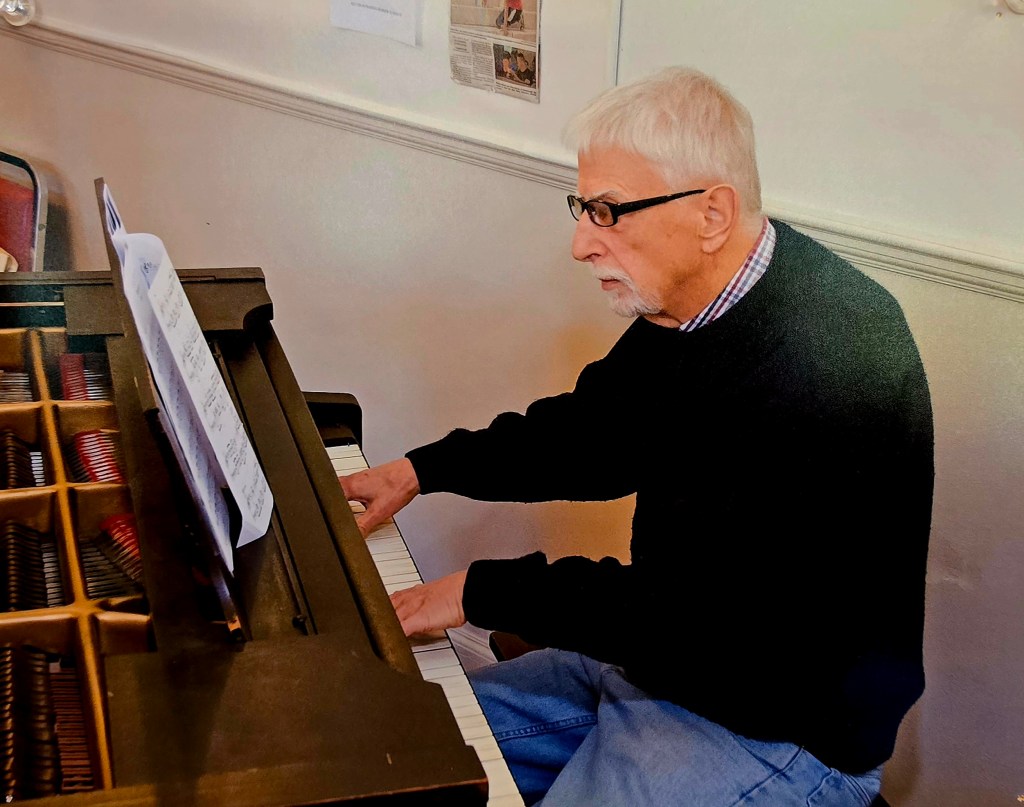
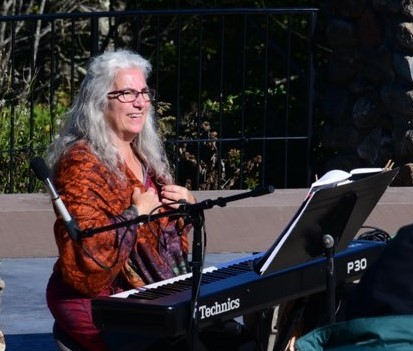
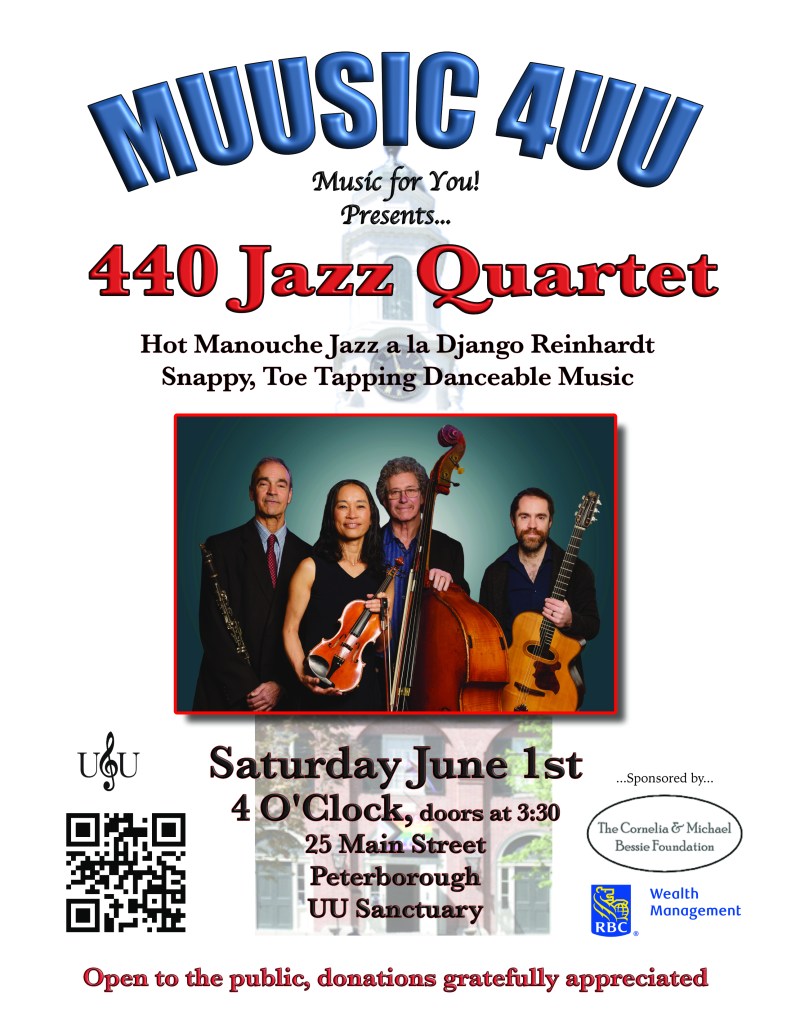
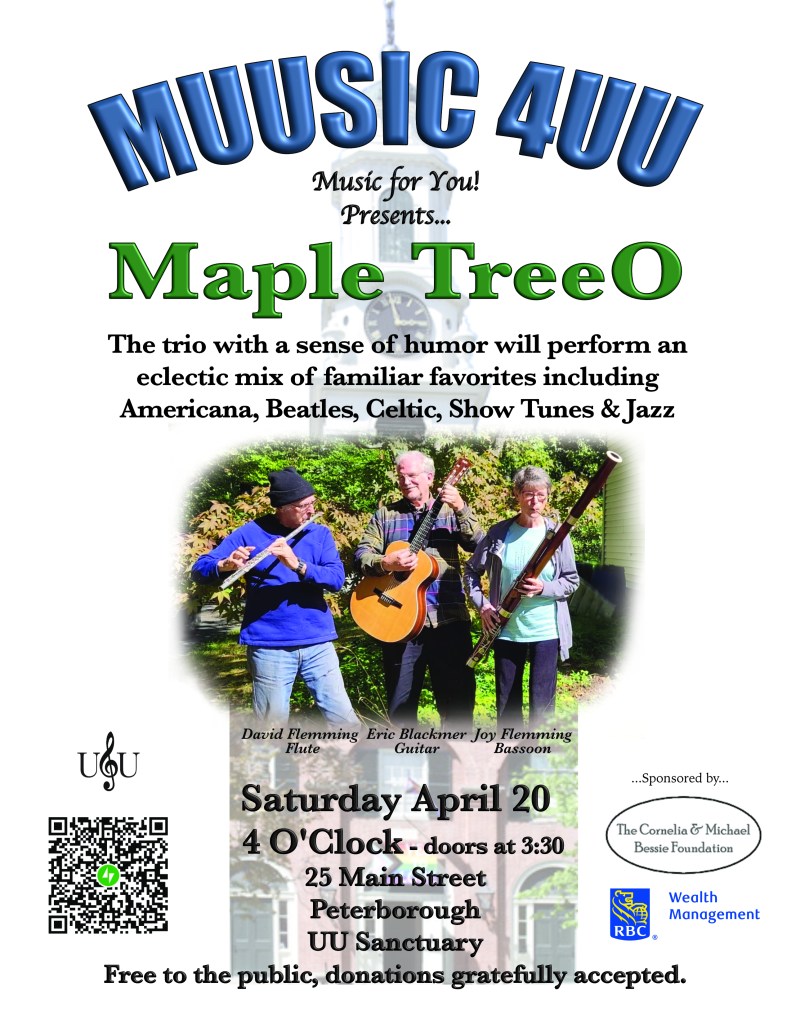
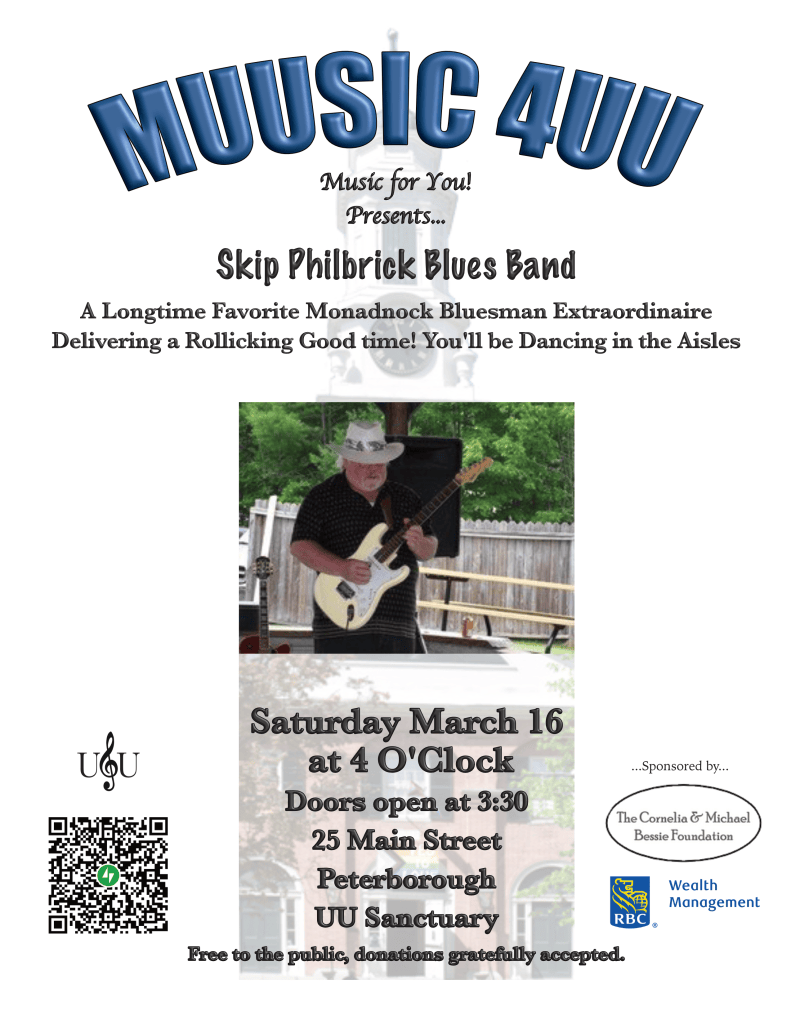
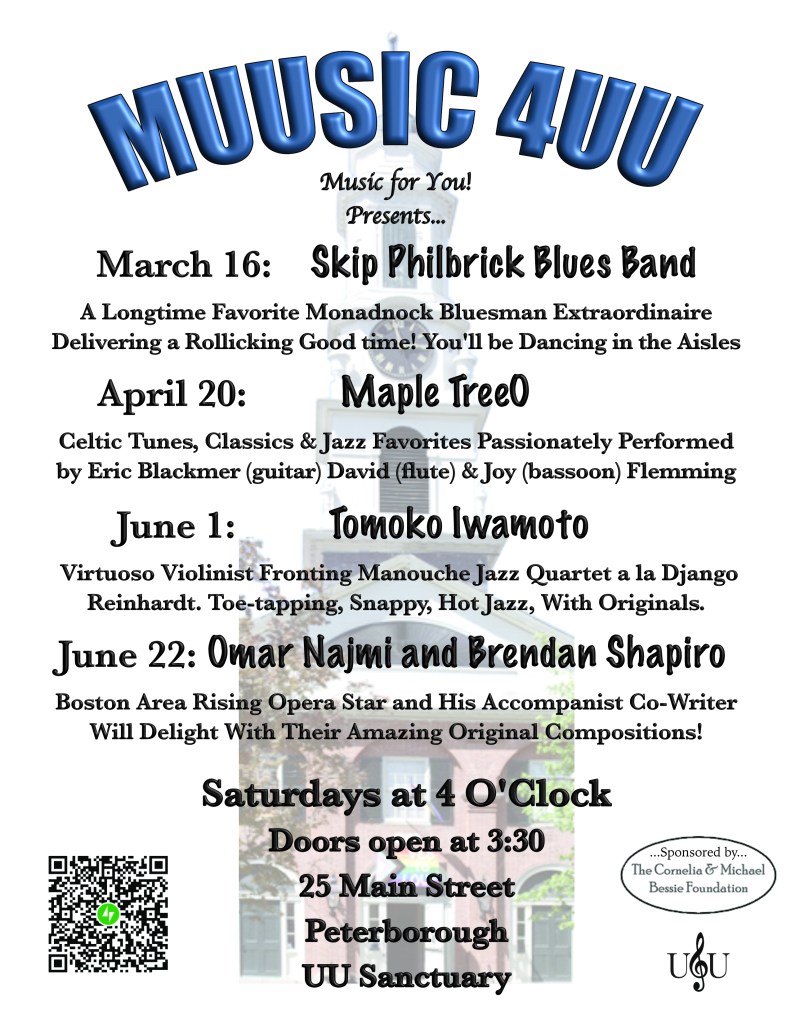
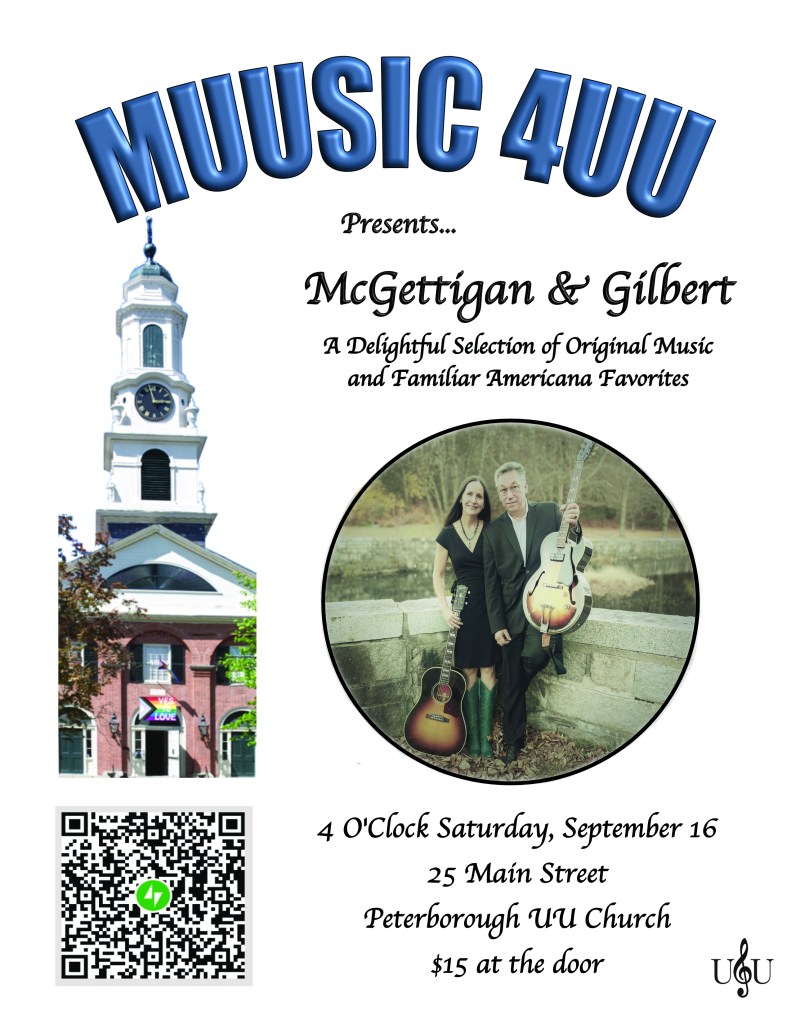
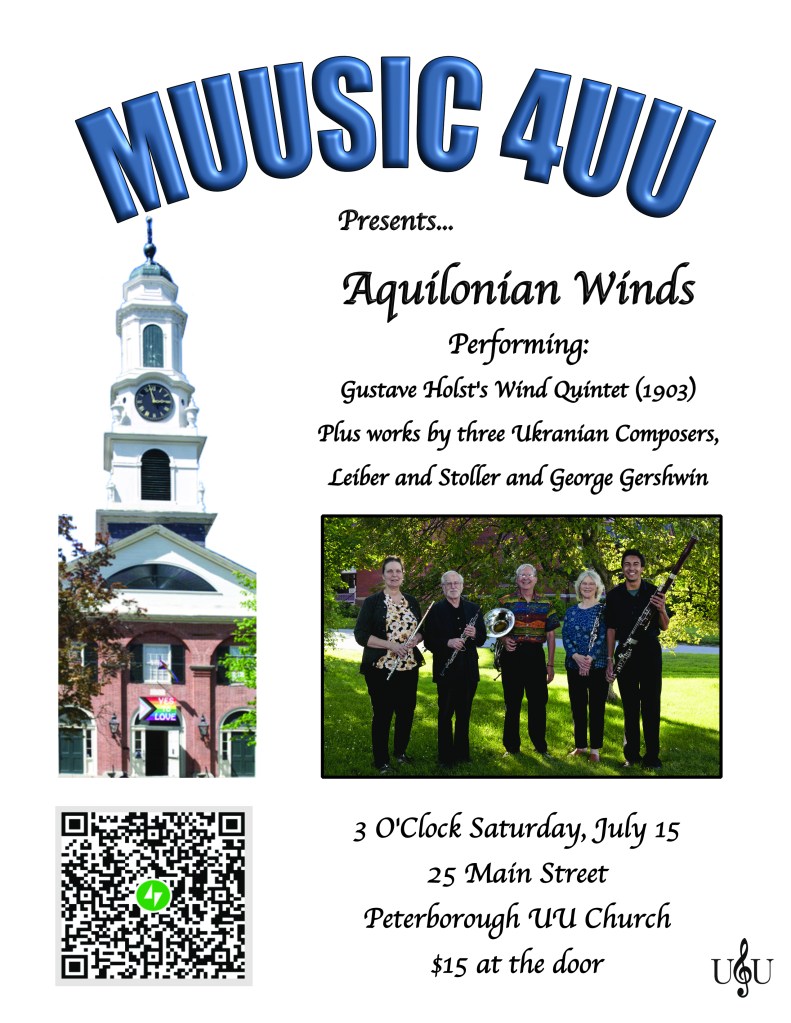
The Muusic 4UU (Music for You!) concert series is the realization of a dream shared by a group of music lovers at the historic Peterborough Unitarian Universalist Sanctuary. Our committee is dedicated to showcasing top talent of the Monadnock Region.
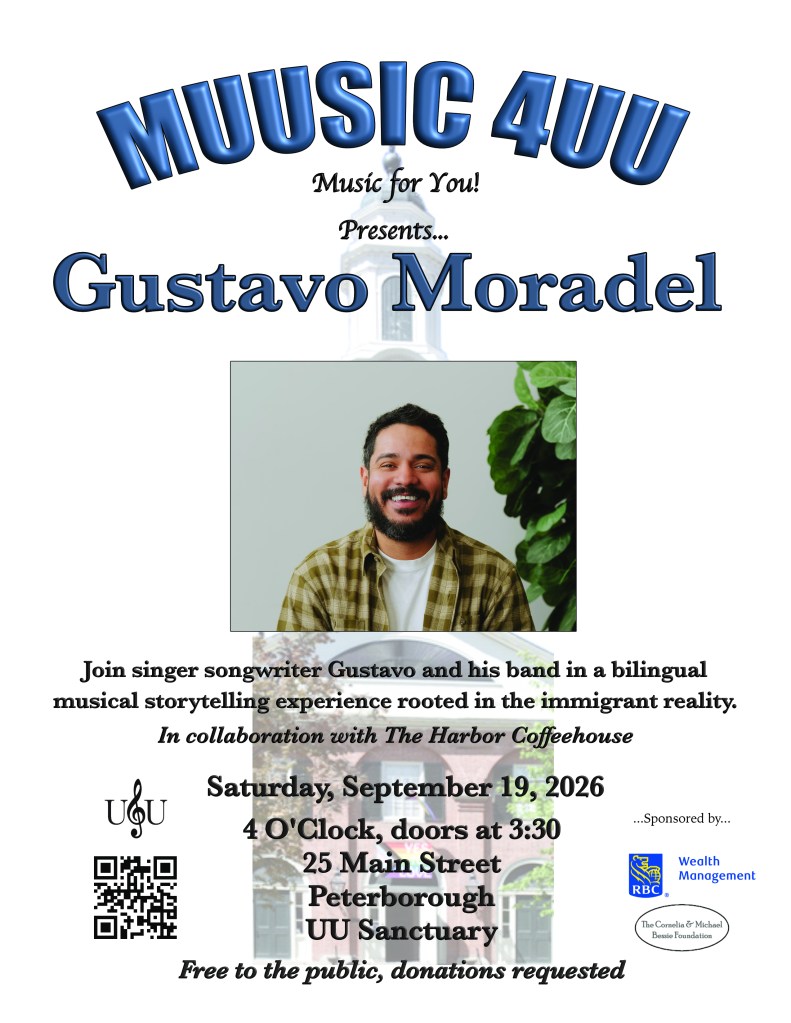
Gustavo Moradel:
Music-making for the Greater Good
Gustavo Moradel’s life story as an immigrant is a testament to the transformative power of music and advocacy. Through his tireless efforts, he continues to be an advocate for the voiceless, a beacon of hope for dreamers, and an inspiring figure for everyone who encounters his uplifting music and message.
Saturday’s concert will be a real treat for the audience of our season opener with Moradel who will be appearing with his band, including Paul Godoy on keyboards and synthesizers, Isai Peña Cruz on electric guitar and Alex Guerrero on bass and percussion.
It comes as no surprise to most that being a musician and an advocate often go hand-in-glove. Gustavo Moradel bring a long history of both to his performances. He was born in Honduras and has recently made his home in Peterborough, but what has happened in these in-between years is what makes his career an amalgamation of Artist and a Voice for Justice.
Moradel brings to Muusic 4UU a band that is, in his words “a soulful blend of folk, rock and Latin-American music.” However enticing as that is in our parts, it is the singer-songwriter and storytelling that explores identity, love, immigration and the stories that connect us. Moradel is a master of “creating an intimate and vibrant live experience that bridges culture and musical traditions,” also his words. The “master” part is what we as an audience will suggest as we long for an authentic, healing experience through music.
Those in-between years are significant, and his website offers us the best description:
Gustavo has been invited to advocate for DACA dreamers, shedding light on the challenges and aspirations of undocumented immigrants in the United States. His efforts to raise awareness about DACA and support for the undocumented community have led him to perform at significant events, including the Democratic National Committee, where his voice resonated with policymakers and activists alike.
The reach of Gustavo’s music extends beyond the political sphere. He was invited as a guest musician by former President Clinton for his Clinton Foundation event, allowing him to use his artistry to support various philanthropic endeavors and inspire positive change on a global scale.
So for him to describe his music as a “moving blend of Latin American folk, Americana and storytelling that celebrates resilience, memory and community” doesn’t do him full justice. Clearly the man has had an interesting life, but none of us who have touched the shiny surface of fame are the sum total of that which rubs off.
From where this writer stands, as a musician and humanist, the first question in an in-depth exploration of an artist relates to that artist’s output: in Gustavo’s case, his music. With such deep roots in Latin American culture, what is the gravity which pulls every new transplanted musician to the center of American culture? He said:
I don’t think I ever consciously decided to combine American folk and rock with Latin American music. It happened naturally. I grew up with Latin American music, and later fell deeply in love with American folk, rock, and singer-songwriters. Eventually, I realized they weren’t really separate worlds. To me, folk music is the music of the people, wherever in the world it comes from. American roots music, just like Latin American folk, has strong African influences, alongside Indigenous and European traditions. The rhythms may sound different, but there’s a shared language underneath them: storytelling, groove, and the human experience. I think that’s where the magic happened. I simply let all those musical worlds I love speak to each other.
Let’s also not forget that all musicians have to start somewhere, and that careers often will take a sudden fork. So the magic is not just in the artist’s own reflections and the conjugations thereof. Magic also comes in who comes across one’s path and Gustavo has a great story about this as well:
One of my favorite bandstand stories happened at a tiny Mexican restaurant in Nashville. I was playing a show there one night and decided to play “I’m a Believer” by The Monkees. After the show, a gentleman in his 60s came up to thank me for the music, and we started talking. Long story short, I found out he was Pete Finney, the pedal steel guitar player who had played on The Monkees’ music and a legendary Nashville pedal steel player. What started as a random conversation after a little restaurant gig turned into a friendship. A few months later, Pete was playing shows with me, and we actually got to play “I’m a Believer” together. You really never know who is going to walk through the door at a gig. Sometimes the most unexpected moments become the stories you carry with you
We can see that Gustavo is unabashedly positive and optimistic, and we should be glad of that. However, if I had an active performance career in Nashville I would be thinking twice about moving to Peterborough, no matter how nice it is. Gustavo’s relocation from music city U.S.A. happened last April and he has expressed his love of the area. We should be so lucky. How often is it that we get to enjoy such an artistry that comes with a energetic drive to make things a little better?
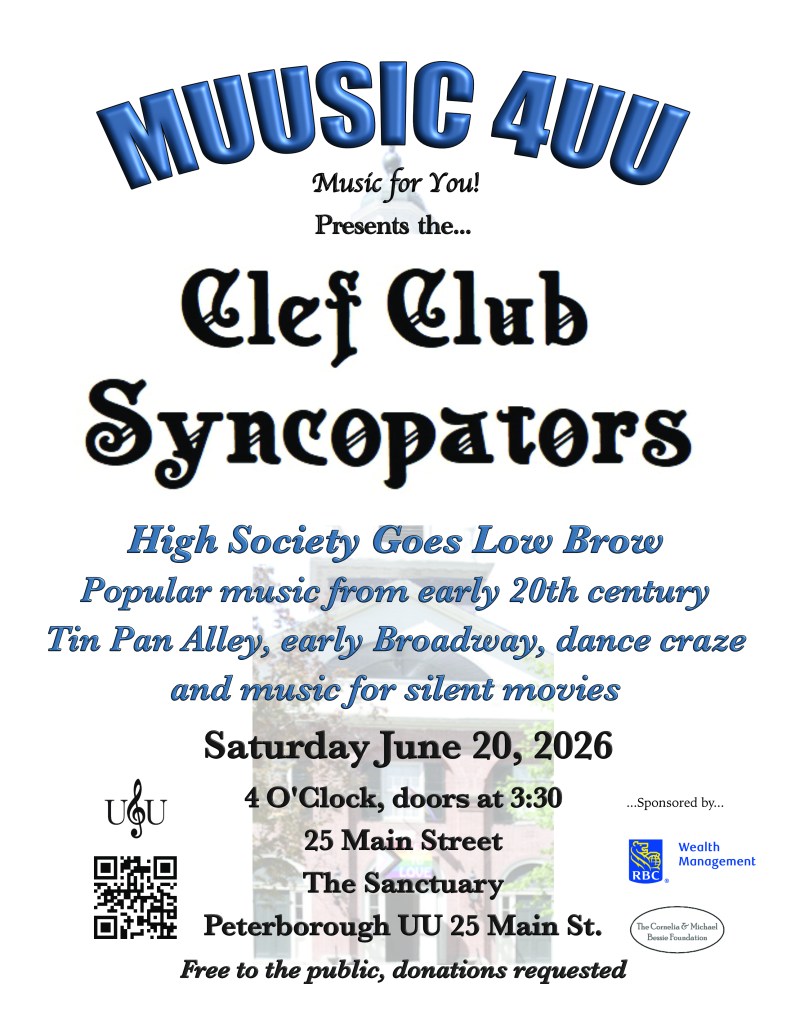
This blog feels a little odd to me, not just because I’m part of the band listed above, but because I am having some difficulty with the concept of interviewing myself. Clef Club Syncopators is a part of my musical history – emphasis on history – that dates back to my Conservatory days, full of the heady thrill of playing music I was in love with. And that music was all about the first three decades of the 20th century.
Clef Club Syncopators was at that time a strictly reading band – no improvisation – playing from stock arrangements culled from a large collection of music given to me by local Boston bassist, Steve Pratt. Clef Club was the band that I ran counter to two other bands: Happy Feet Dance Orchestra and Charles Street Jazz Band. The former was my main gig – partly reading/ partly improvised that performed a specific repertoire made up of music from the early books of Duke Ellington, Don Redman, Fletcher Henderson, plus a bunch of stocks that we “opened” up. I transcribed much of our book off recordings on tape from old 78 rpm records; later I began to write original arrangements but always preferred the transcriptions because of their historical accuracy. Charles Street was just a plain old Trad. Jazz band, all improv.
But Clef Club Syncopators filled a difference niche. This music was earlier than the other two bands by a decade or two, although there was overlap. The purpose was to provide dance music for dance hobbyists who were into the multitude of dance styles from those first two decades. And so we played for them in Newport, in Concord, in Boston, but we never really performed as a band for entertainment purposes.
I named the band after what I thought at the time was a New York nightclub that provided music for dancers Irene and Vernon Castle with their house arranger Ford Dabney and his cohort of composers that included James Reese Europe. Later I realized that I had conflated the activities of the icons of the Dance Craze that started around 1907 with the organization that Ford Dabney had started: the Clef Club. The two are separate but deeply intertwined.
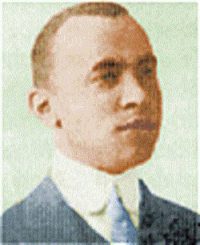
Ford Dabney was a ragtime pianist who never attained the recognition given Scott Joplin, but nevertheless was a vital figure in the development of the music scene in New York City in the 1910’s. Together with fellow ragtime composer James Reese Europe, they worked to create musical opportunities for local black musicians and fostered a group to better the lives and working conditions for them. To this end they formed a club – sort of a union – that also had an orchestra associated with it. This was Clef Club, a club, a union, a band – all things musical for black residents of New York. Here is their mission statement:
We, the members of said organization, have established, organized, and incorporated the Clef Club of the City of New York, in order to inculcate the science of vocal and instrumental music, technique, and execution of vocal and instrumental music, and to promote good fellowship and social intercourse.
The original Clef Club organization and orchestra flourished, and with it Dabney’s fortunes. He collaborated with Vernon Castle in developing tunes that best supported the fluid athleticism of the Castles’ dance demonstrations. He also composed a number of tunes that became standards, such as Shine, and for a short time he owned a theatre in Washington DC. But consider this: Dabney’s contribution to music arts in New York was not just enormously significant to the African American community but to the development of American popular culture at large. And this happened ten years before the Harlem Renaissance.
* * *
The new Clef Club Syncopators, which retired in 2000 and was reborn this year is reflective of that mission from a dim mirror to the past. We play the music of the time, but no longer just for dancers in period costume. We’re actually paying it backwards to the culture of the time, the optimism, the joy and enthusiasm along with all the hokey theatrics and overacting. So while our music is homage to the tremendous significance of the African American influence on popular culture, it also takes a broad swipe across the culture of the day and what it means to us now.
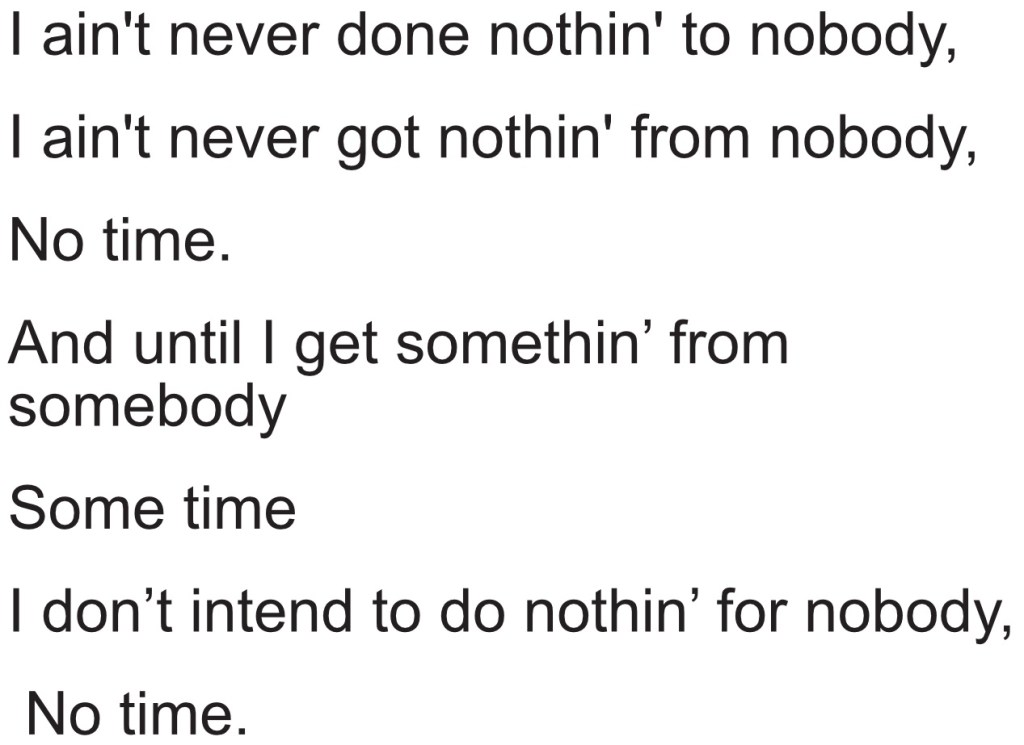
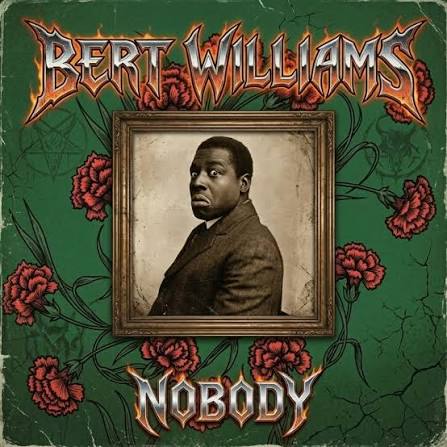
Along with a shout out to the composer/arranger team of Dabney and Europe in Castle House Rag, we also have a heavily mannered ballet theme by Cecile Chaminade, the French composer who had the sense to publish on Tin Pan Alley. We have George Gershwin’s piece Rialto Ripples which he co-wrote with Alley compatriot Will Donaldson. Gershwin was boy of 19 and a plugger on the Alley at the time. We give a hearty wave to Bert Williams, the first African American comedian who influenced all comedians going forward and who re-recorded his hit Nobody at least six times because it was, well, successful. And we would be remiss if we didn’t include music from the greatest entertainment technology of the time: silent movie music by Julian Andino, another composer of Afro-Cuban birth living in New York at the time.
Those tunes, plus a few peppy numbers of the times and a Grand Waltz make a cross-section of what people listened to at the time. And it was all either in a club or at home. Radio didn’t exist yet, and recorded music was still pretty much reserved for people who afford the devices. Our job is to give our best reinterpretation of the sounds of the times. We hope it brings something positive to you listeners as well.
Here’s my interview with myself:
Interviewer: What would you say was the greatest influence on the development of your musical tastes.
Lucinda: So many tunes, so little time.
* * *
Making Music: Generational Positivism
How do we musicians do what we do? Not speaking of making music, but of making a living doing music (or not). For those fans of good music whose experience and knowledge of this craft is limited to opening up their Spotify setlist, or even more arcane, tuning to your favorite FM station, learning how such a career is built is eye-opening.
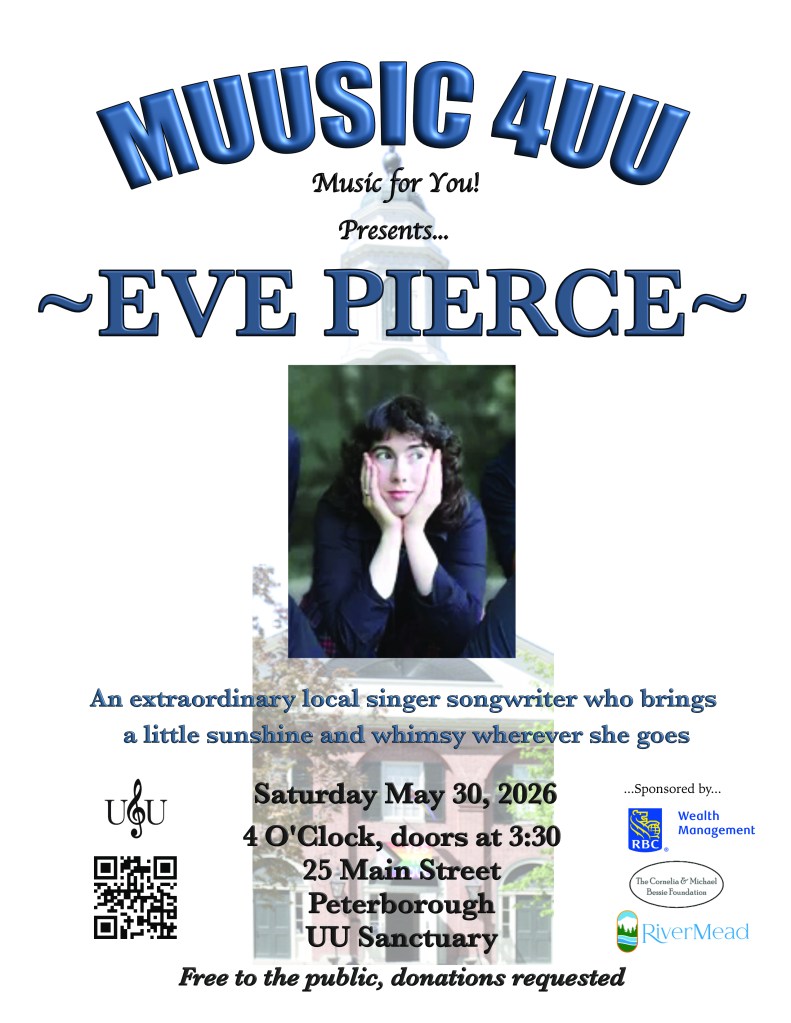
For those of us who enjoy the re-creation of music written before us rather than create our own, as is the specialty of singer-songwriter Eve Pierce, we often reflect on the lives of past musicians; how they lived, how they got by, how they made themselves known. Careers have a trajectory, and as I considered my own while preparing to write this blog, I wondered if youngsters today are having a different experience: do Gen Z musicians have a different path from us Boomers?
They don’t. Not really. We made cold calls. She writes cold emails.
Eve Pierce is the local girl made good. Uncertain whether it is good enough for her, she didn’t say. But she is so very young and has so very much going for her so her success is already evident and in her hands. She could probably make a living bottling and selling that wonderful enthusiasm, but lucky for us she has better things to do.
Where this all starts is, er, in utero. (Yes, music does cross the placenta. I know this for a fact.) Coming from a musical family and a mother who sings, Eve decided to be a songwriter early on – elementary school she tells me – but decided she wasn’t any good at it, later changing her mind before she graduated high school. How nice it is to discover yourself wrong!
In this country we are now going on 125 years of history of songwriting; the singer-songwriter phenomenon began mostly in the 1960’s with some precedent from the folk music revival in the late 1950’s. That’s a half century of evolution of what is now a well-established art form. What is interesting in Eve’s background is the diversity of her sources, a statement that bears some explanation. Singer-songwriting is such a general topic; the diversity of styles, approaches and ethnicities is a gigantic contribution to the genre such that Eve’s choices are notable, those being The Beatles, Paul Simon, the Mountain Goats and Neko Case.
Let’s unpack this. Skipping over the Beatles, because you know, they’re the Beatles (you can’t say a small amount about them and avoid not saying enough), Paul Simon was best as a balladeer with an ironic twist to his humor. The Mountain Goats are straight-ahead three-chord punk with themes tending toward the darker side. But Neko Case is an odd duck. Briefly, (other than the fact that I had never heard of her and so needed to do some research) Case is from Ukranian roots, has spent most of her time in Tacoma, Washington and Vancouver BC, and her music comes from a wildly broad set of sources including punk, indie, honky-tonk, rockabilly, and country.
How does this get back to Eve Pierce? Well, I was particularly taken with one of her songs: Gargoyles.
What are gargoyles my love and why do they watch me so with cold stone eyes my love they watch us here below….
Who are you now, what does that make of me? Only a fool thinking you’d wait for me. What are we now my love and why do you watch me so. You sit above and I fall below.
I’ve always been falling I see no reason to stop now. Let yourself go! Forget that I’m stone! Throw your chisel out the window, let me be known! Unwitting Pygmalion; inhuman Van Gogh
You sculpted my visage from violence and snow. I am your masterpiece, your folly in art. So why does it feel like I’m falling apart?
What are gargoyles my love and why do they watch me….
I’ve always been falling I see no reason to stop now, don’t let me go …
You left your monster to fend for herself. Did you consider that this monster felt … I’m sure if you cut me I won’t bleed, Men like you were made for monsters like me.
The song is catchy and the lyrics capture the zeitgeist of relationships today. They’re vulnerable and a little angst-y, but youthful and hopeful. But isn’t this the zeitgeist of every generation? It’s the whimsical imagery of a gargoyle as Eve applies it to her possible state of mind combined with background vocals that bring to mind Dan Hicks’ songs where his back up singers the Hot Licks doot-doodled their rather acidic corroborations to Hicks’ hard irony.
This is taking a serious topic and looking at oneself in the mirror with a twinkle in the eye and the ability to laugh at one’s own frailties and downright silliness. That is a strain that courses like an aquafer through the singer-songwriter tradition, topics that explain the seriousness of the human condition while including a strong positive streak. Positivism that makes you want to sing. Humor that keeps you going. A disposition that leans towards self lampooning. That is what has gotten every generation of musicians through the tough job of creating a career in music. We had it.
Eve has it.
* * *
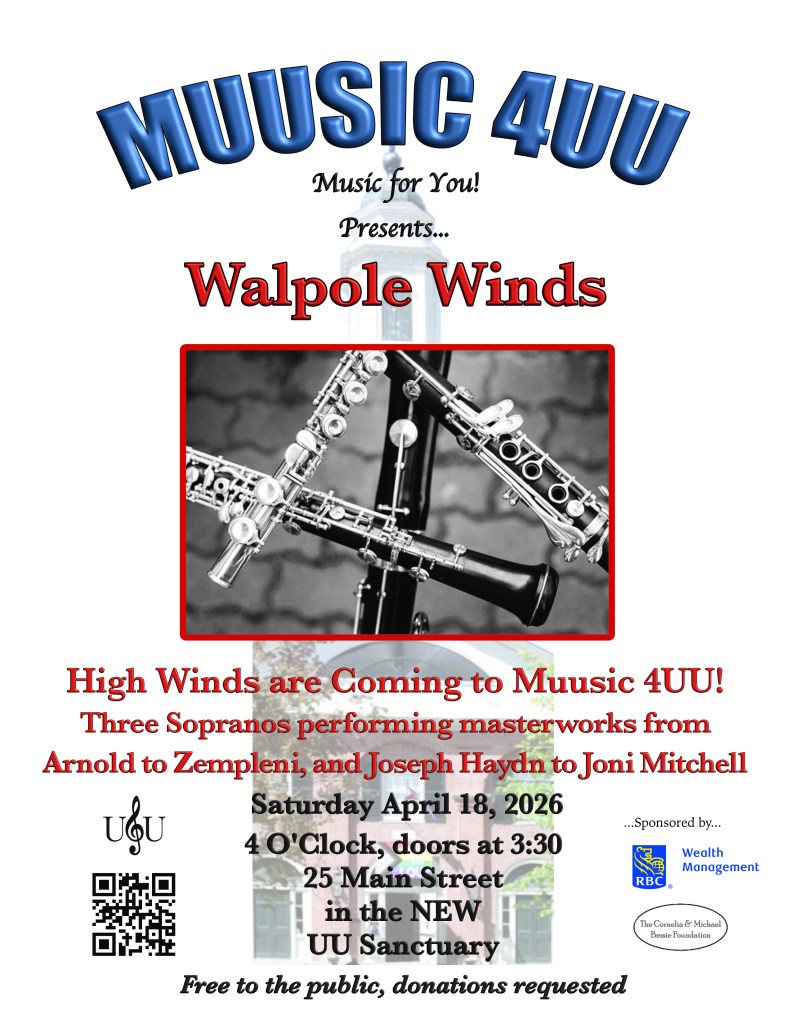
Julie Armstrong, flute Gary Nosenko, oboe Mary Seaver, clarinet
Three Voices from Many Sources
In recent years, musical ensembles have tended to fit the size of the times. Larger ensembles are difficult (and expensive) to establish, and composers have been composing for smaller forms. The problem often is fitting the music to the instrumentation at hand. Choosing from an ever-increasing and vast supply of resources requires deep searches into ancient collections — being a music librarian is no easy task. Arranging skill is also essential to morph parts from one set of instruments to another, often requiring doubling on the parts of the musicians — from B-flat clarinet to Bass clarinet, for instance. Or rewriting violin parts to suit wind instruments. Quoting from their communication with us:
Chamber works for flute, oboe, and clarinet are comparatively rare, mainly because the ensemble lacks a true bass instrument. Only two of the entries on our program — those by Arnold and Wailly — are originally scored for this combination. (Mary Seaver plays bass clarinet on a few of today’s pieces.)
In the case of Walpole Winds, sometimes a quartet and in this case a trio, all the skill needed is at hand. Their program, made up of an eclectic mix of popular, modern and baroque and classical periods, is soothing and rollicking by turns; sounds that are as familiar as the am radio many of us played incessantly during our younger years but always reflective of our cherished musical traditions. So let’s break it down more or less by period.
* * *
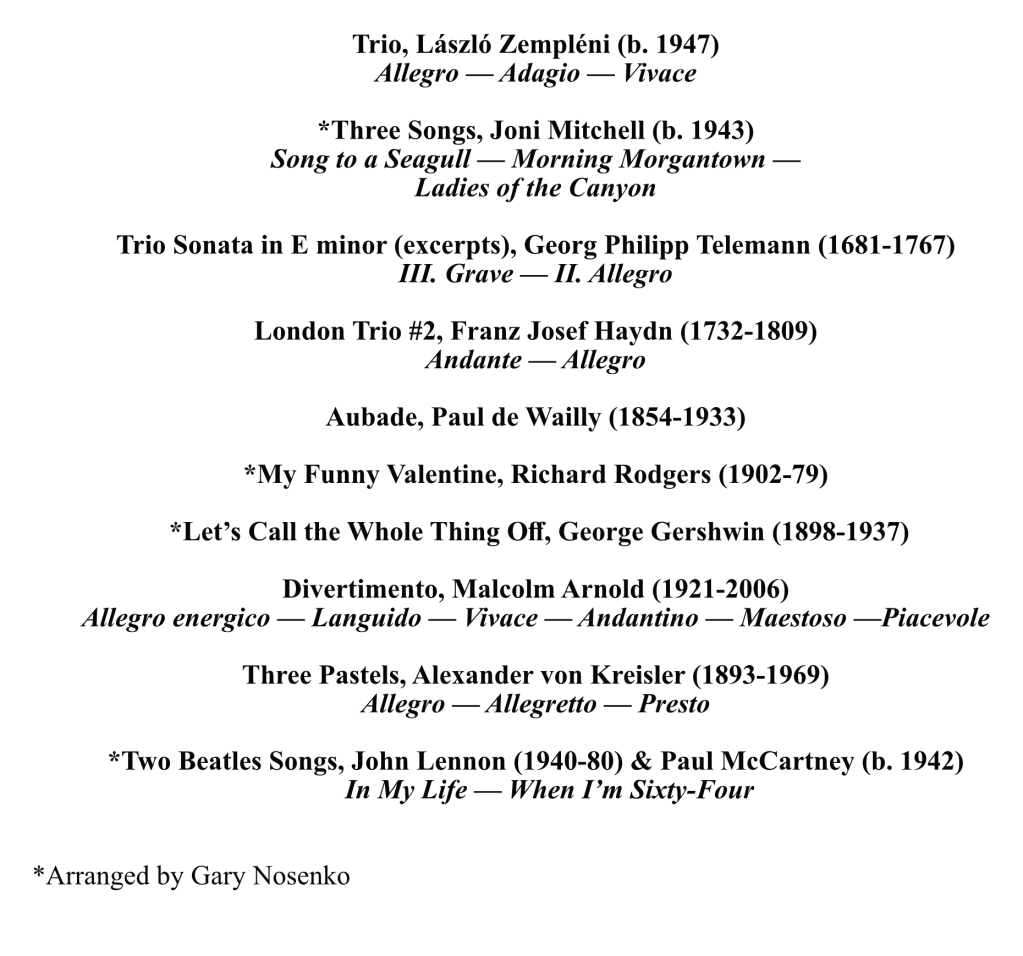
Program
Notes
Georg Philipp Telemann, [Trio Sonata] J. S. Bach’s contemporary, was both vastly more prolific (if you can imagine that) and more popular. He and Bach were friends, but Telemann tended to beat out Bach in getting the best gigs. Essentially self-taught in composition, he absorbed influences from many national traditions. He outlived Bach by seventeen years, well into the rococo period; the style of his late works infringes on Haydn and Mozart territory.
Speaking of Franz Josef Haydn, the London Trios (1794) were originally for two flutes and cello. Haydn gifted the work commemorating the Baron of Aston of Preston, an industrial town north of London. The scoring was unusual for its time, but the flute had recently become fashionable in England. After the flute fad faded, the trios practically disappeared from programs until the early twentieth century.
Moving forward a century, the French composer Paul de Wailly is perhaps known more for who he knew than for his own works. This is a bad break, because his music is beautiful. He worked in the spheres of Cesar Franck in his early years and Erik Satie into the twentieth century. Scored for Walpole’s instrumentation of flute, oboe and clarinet, Aubade is a lovely tone poem, giving us the stirring of leaves in the morning breeze, along with the raucous squawking of early birds. A passionate passage late in the work suggests a lovers’ lament at parting.
Alexander von Kreisler [Three Pastels] was born in Russia but moved to the United States soon after the Soviet Union was formed. He was educated in law at St. Petersburg, but evidently transferred over to the St. Petersburg Conservatory in 1916, studying with Glazunov and Tcherepnin. He emigrated to America in 1927 to work at Cincinatti Conservatory, chairing the opera and orchestral departments and broadcasting weekly CBS concerts, most of which are lost forever. The last two decades of his life was at the University of Texas, teaching orchestration and conducting, and it was during this time that he produced most of his works for small chamber ensembles.
Malcolm Arnold was one of the most prolific and successful 20th century British composers. He wrote not only symphonic, choral, and chamber music, but five ballets, two operas, many works for wind band, and over 100 film scores, including the Oscar-winning score for The Bridge Over the River Kwai. His six-movement Divertimento covers a wide range of moods, from lyrical to regal to giddy.
Hungarian composer, educator, percussionist, László Zempléni studied at the Franz Liszt Academy in Budapest and tympanist for the Hungarian State Opera Orchestra. His widely published works include books of transcriptions, arrangements and original music, scored for flexible instrumentation including winds, strings and percussion. The Trio is originally scored for three flutes and a perennial favorite of musicians and audiences. The opening Allegro is full of life and energy with all three flutes swirling around a folk-style dance. The evocative Adagio is hauntingly beautiful and leads straight into a rumbustious Vivace with its cross accented rhythms and sudden changes of dynamic.
Song to a Seagull, Morning Morgantown, and Ladies of the Canyon are early songs by Canadian singer-songwriter Joni Mitchell. Her music was a staple in any collection of 1960’s “urban folk” movement, but her style often combined elements of jazz, transcending the simple sounds of folk and protest into something much more complex. As Wikipedia reports, starting in the mid-1970s, she began recording with jazz musicians Wayne Shorter, Herbie Hancock, and Pat Metheny as well as Charles Mingus, who asked her to collaborate on his final recordings. She later turned to pop and electronic music and engaged in political protest. She was awarded the Grammy Lifetime Achievement Award in 2002.
The Beatles’ songs In My Life and When I’m Sixty-Four need no introduction, though it’s worth pointing out that the baroque-style interlude in the former was played for the studio recording by their producer, George Martin, on piano at a slow tempo, then dubbed in with the tape speeded up to sound like a harpsichord. In the latter, a song McCartney wrote as a teenager, the recording employs a trio of two standard B-flat clarinets and one bass clarinet.
My Funny Valentine (Rodgers and Hart) and Let’s Call the Whole Thing Off (George and Ira Gershwin) are two classics from what has been termed “The Great American Songbook,” those thousands of songs written in the first half of the 20th century for Broadway shows, Hollywood films, vaudeville theaters, and dance bands by the composers (mostly “ethnic” Americans: Jewish, Italian, Black, etc.) who churned out material for the music publishers in New York City’s “Tin Pan Alley.”
* * *
* * *
Lining It Out — Joy in the Collective Voice
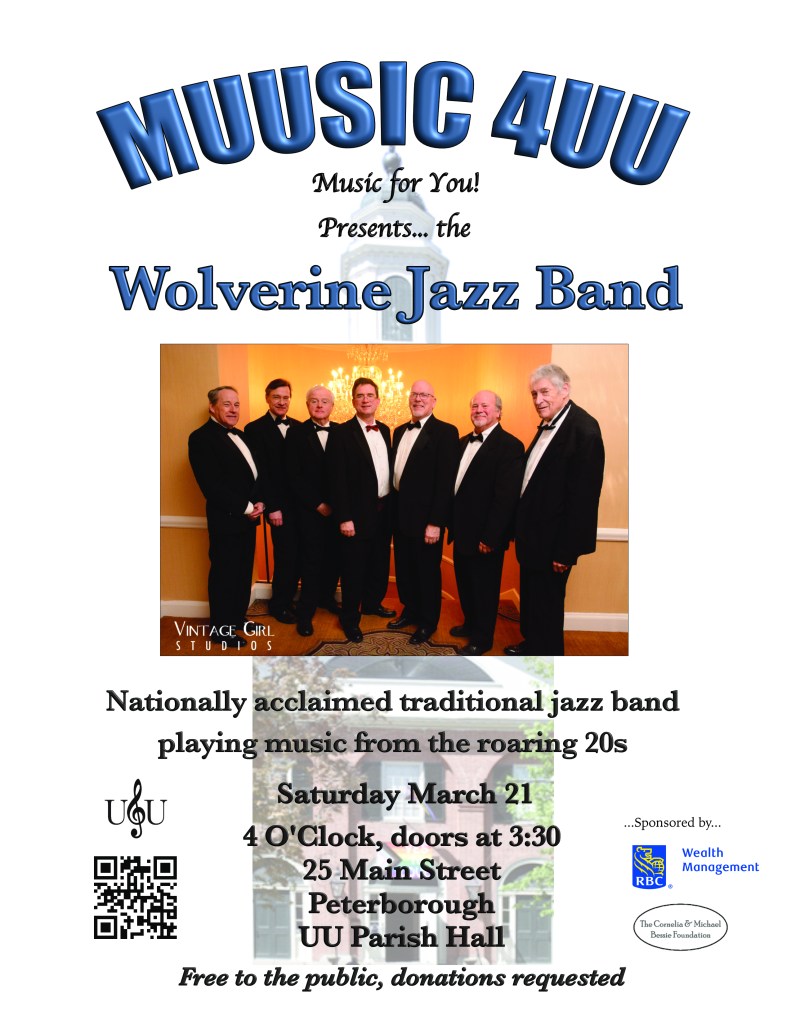
The one thing about Traditional Jazz that probably has always attracted me most is the pure, unadulterated joy in the music and the sharing thereof. Wolverine Jazz Band is a collection of musicians steeped in that tea of good times, joy and just plain fun.
When I was a 30-something dance band leader, John Clark was just a kid on the block with his clarinet in hand and a hopeful expression that wanted to be included in on the fun. He did Happy Feet Dance Orchestra proud when the band needed it most, and there starts his story with my bunch. I found out more about this now-storied band leader when I asked for some background on Wolverine Jazz Band.
I first got into swing by listening to some Benny Goodman records my father had. He got me a New Black Eagles record when I started to play clarinet, but it took me quite a while to warm up to that style. My natural geeky inclination took me to the library when I was 12 or 13 to learn about Jazz and I found lots of information (and recordings) of the early New Orleans players like Dodds, Noone and Bechet and started my listening life. By the time I got to college I had amassed a pretty good record collection and was fairly fluent in my traditional jazz vocabulary. I would also be remiss in not crediting Ray Smith and his great radio show “The Jazz Decades” for a significant part of my education, culminating in my playing with the last version of his Paramount Jazz Band .
To translate that quote for the curious, Jimmy Noone, Johnny Dodds and Sidney Bechet are to jazz what Beethoven, Mozart and Brahms are to classical orchestral music, except more on the fly. Traditional Jazz (aka “Dixieland” which is now considered pejorative in most circles) is so quintessentially American that we hardly think of how universal it has become. Yet it is the perfect example of a social interaction. Community is baked into the performance practice of the trad. band — the very act of playing the ancient form of call and response, so beautifully loaned to us by its originators, is a way of sharing ideas. Call and response developed into full -chorus solos, giving each player their voice.
Without an audience, the whole thing falls rather short of these democratic ideals. Jam sessions, so popular in trad. jazz circles, are social gatherings where the best ideas happen. Just the band playing is a … rehearsal. And a rehearsal is basically just the outline.
The alumni of Wolverine Jazz Band are now old-timers. Many dating back to the glory days of the New Black Eagles (who, by the way are still in their glory days). Jimmy Mazzy on banjo is the Plato of Minstrelsy, Jeff Hughes has been blowing his horn since before the walls came down. Well, ok, none of this is true, but given that trad. jazz has been through several revivals since the 1950’s, those of us who can remember those days have something to say. And that something is a huge body of music that dates back to the very beginnings of the American Songbook, plus the entire catalog of blues and ragtime. Throw in some Tin Pan Alley and a bunch of novelty tunes we’ve all but forgotten and and you have something to say. Then, add a few fresh faces like Dave Didriksen on drums (say that fast three times), John Clark on clarinet and Ross Petot on piano you have new life.
The 1920’s were kind of a special time. Lots of good music and fun times if you forget about the rank stupidity of an administration that more or less created a crime wave by trying to prevent people from drinking, or the spectre of fascism looming on the horizon. I say these things advisedly and under supervision.
So in the spirit of letting the music speak for itself, I asked John to help me out with some definitions of the entire vocabulary of distinctive slang terms that the 1920’s engendered. Here they are; help me out if John missed the mark.
Hoosegow — A traditional Chinese houseboat
Big cheese — Only a happy memory for me unless I double up on my cholesterol meds.
Flapper — I should think of something in the 20’s, but the only image I have is of the dingus that floats in the toilet tank. Probably has some musical association, come to think of it.
Palooka — A Polish expression meaning “productive sneeze”
Hot Tomato — Goes with “Flapper,” although it’s hard to combine with the toilet metaphor.
Wise guy — Visited Bethlehem with two friends from the old neighborhood.
The Muusic 4UU Celestial Brassdirected by Daniel Walker
Program
Brass
Fanfare – William Walton
Bells
O Hanukkah – arr. Eileen Laurence
Light in the Darkness – arr. Margaret R. Tucker
A Thousand Christmas Lights Are Lit – arr. Sandra Eithun Commissioned in memory of Mary Divers, Co-Founder Granite State Ringers
Silent Night – arr. Cynthia Dobrinski Kelly Brown and Meghan Fossum, Flutes
Brass
And the Glory of the Lord – G.F. Handel arr. Thomas
Christmas Jazz Suite – Bill Holcombe
Bells
Diminished Minor Alterations – arr. Chris Peck
Rondo Passacaglia – arr. Cynthiua Dobrinski
A Holly Jolly Christmas – arr. Joel Raney Hilary Justice, keyboard
Peace – arr. Kurt Meyer
Brass
Just a Closer Walk With Thee – arr. Jack Gale
Three Traditional Christmas Songs – arr. John Beyrent Good King Wenceslas Still Still Still Oh Tannenbaum
Bells
Have Yourself a Merry Little Christmas- arr. Joel Raney Laura Halleck, Keyboard
The First Noel – arr. Cathy Moklebust
Carol of the Bells – arr. Arnold Sherman
Brass
Masters in This Hall – arr. John Beyrent
Holiday Sing Along!
* * *
Program notes:
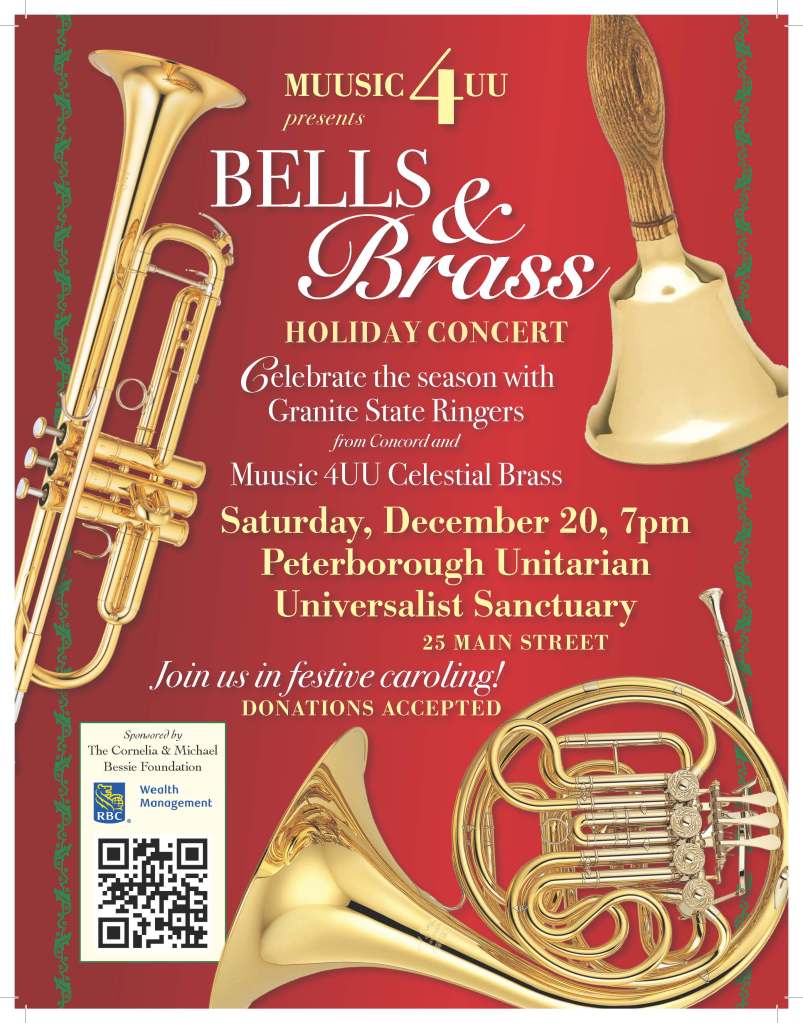
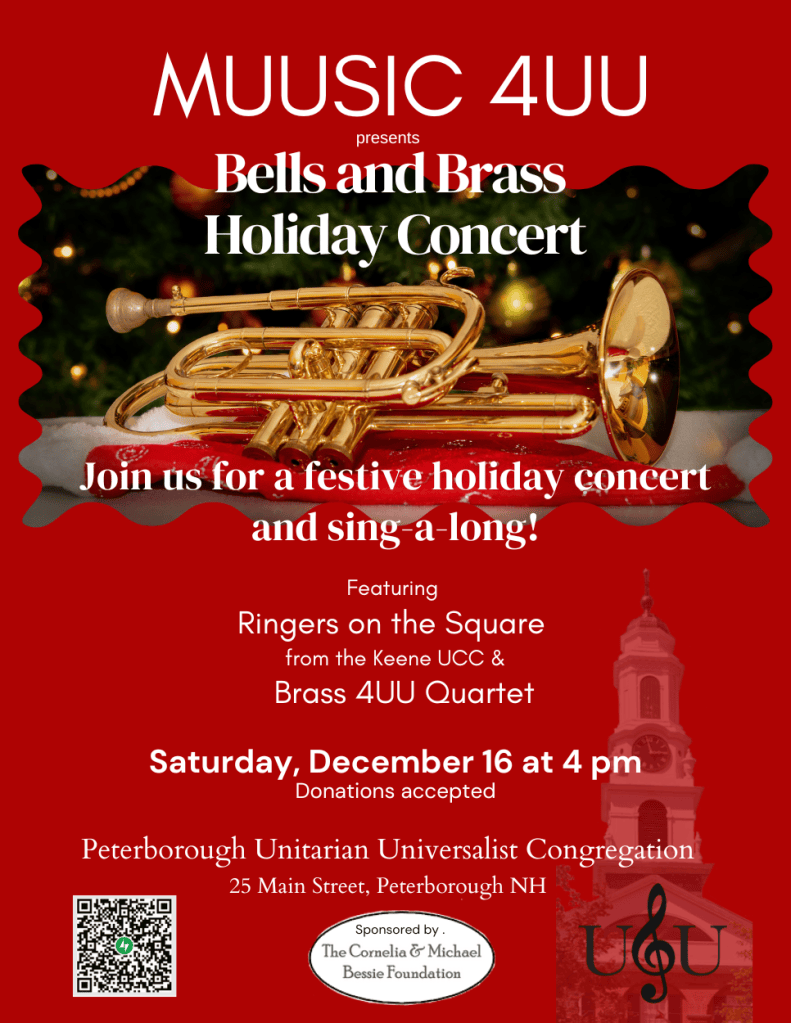
With the glint of shiny brass, and the colors of Christmas, the experience of the sight and sound of handbell choir and brass ensemble is at once festive and thrilling. We welcome the Granite State Ringers to perform for Muusic 4UU; they will join with the Muusic 4UUCelestial Brass for our third annual joyous holiday themed concert in the Peterborough Unitarian Universalist Sanctuary. Holiday favorites and a community sing along round out the program.
Out of Concord, New Hampshire, the Granite State Ringers is an elite handbell choir in New England. Founded by director Joan Fossum and Mary Divers, they have been a non-profit since 2007 with a mission to offer educational programs for youth and adults as well as concerts in support of groups in need, such as NH Food Bank and the Ukrainian Red Cross. They perform on five octaves of Malmark handbells, six octaves of Malmark handchimes, and four octaves of Schulmerich Handbells, a serious piece of change. This is an impressive array of brass: from very a large bell that commands its own table and requires some brawn to heft, to tiny bells which are frequently played “two in hand” by skilled ringers who can ring up to four bells at once.
They program is made up of their 2025 concert series, titled A Thousand Lights Are Lit, which is also the title of one of their signature pieces, which they commissioned. As a group of professional ringers, the audience will enjoy their skill on difficult tunes such as Carol of the Bells. We are incredibly lucky to have them at Muusic 4UU – the group is much in demand this time of year. To find out more about the ringers, go to their website: https://www.granitestateringers.org
A brass ensemble can come in various sizes, from a trio to a large all-brass band, but a quartet or quintet is somewhat the standard for a brass choir. There is tons of music written for this conformation – think “Canadian Brass” who for years has written, arranged and performed brass choir music resulting in (more or less) the canon for modern brass music. And among the best music is written for the holidays – cleverly arranged for smaller ensembles. The Muusic 4UU Celestial Brass includes Sheldon Ross and Richard Tandy on trumpets, David Sporny, trombone, and director Daniel Walker on bass trombone.
Singalong Lyrics
O Come All Ye Faithful
O come, all ye faithful, joyful and triumphant O come ye, o come ye to Bethlehem O come and behold Him, born the King of Angels
O come, let us adore Him … Christ the Lord
O sing, choirs of angels, sing in exultation O come, o come ye to Bethlehem O come and behold Him, born the King of Angels
O come, let us adore Him … Christ the Lord.
Joy to the World
Joy to the world, the Lord is come Let earth receive her King Let every heart prepare Him room And Heaven and nature sing And Heaven and nature sing And Heaven, and Heaven, and nature sing
He rules the world with truth and grace And makes the nations prove The glories of His righteousness And wonders of His love And wonders of His love And wonders, wonders, of His love
O Little Town of Bethlehem
O little town of Bethlehem How still we see thee lie Above thy deep and dreamless sleep The silent stars go by Yet in thy dark streets shineth The everlasting light The hopes and fears of all the years Are met in thee tonight
For Christ is born of Mary And gathered all above While mortals sleep, the angels keep Their watch of wondering love
O morning stars together Proclaim thy holy birth And praises sing to God the King And peace to men on earth
Angels We Have Heard on High
Angels we have heard on high, sweetly singing o’er the plains, and the mountains in reply echoing their joyous strains:
Refrain: Gloria, in excelsis Deo! Gloria, in excelsis Deo
Shepherds, why this jubilee? Why your joyous strains prolong? What the gladsome tidings be which inspire your heav’nly song? [Refrain]
Jingle bells, jingle bells Jingle all the way Oh, what fun it is to ride In a one-horse open sleigh, hey Jingle bells, jingle bells Jingle all the way Oh, what fun it is to ride In a one-horse open sleigh
Jingle bells, jingle bells Jingle all the way Oh, what fun it is to ride In a one-horse open sleigh, hey Jingle bells, jingle bells Jingle all the way Oh, what fun it is to ride In a one-horse open sleigh
Silent Night
Silent night, holy night! All is calm, all is bright. Round yon Virgin, Mother and Child. Holy infant so tender and mild, Sleep in heavenly peace, Sleep in heavenly peace
Silent night, holy night! Shepherds quake at the sight. Glories stream from heaven afar Heavenly hosts sing Alleluia, Christ the Savior is born! Christ the Savior is born
Silent night, holy night! Son of God love’s pure light. Radiant beams from Thy holy face With dawn of redeeming grace, Jesus Lord, at Thy birth
Jesus Lord, at Thy birth
A Warm and Loving Holiday Season to Everyone!
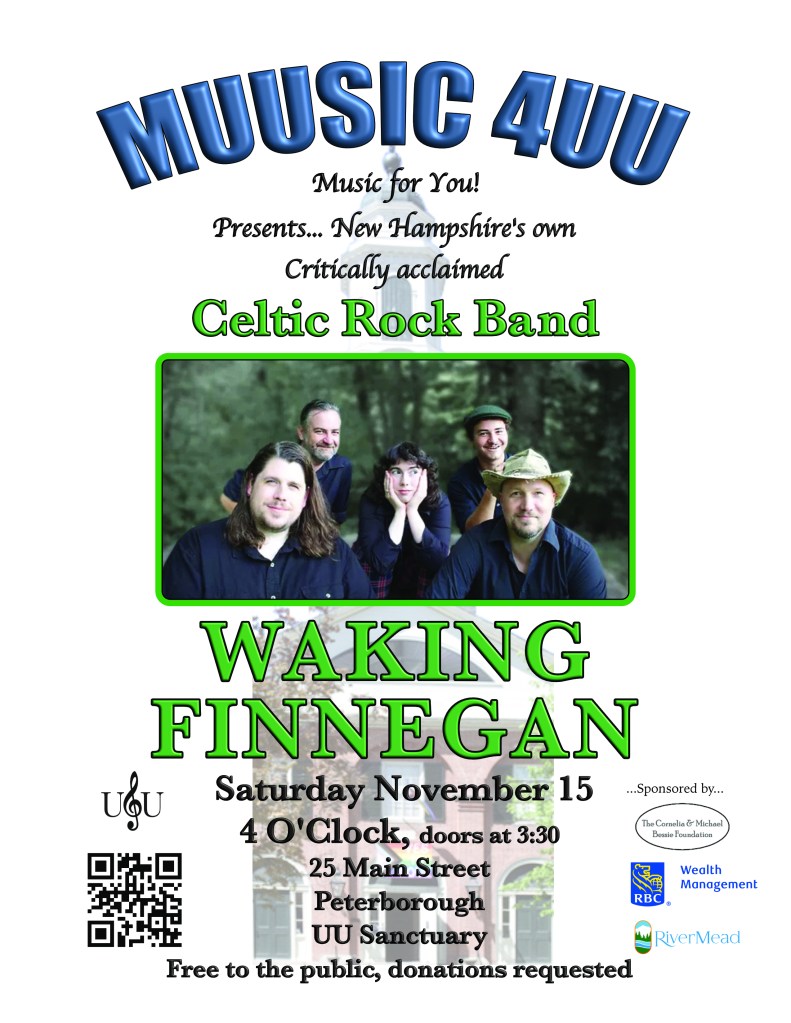
Maple Grove to play on November 15th
Due to unforeseen circumstances, Waking Finnegan will be moving their performance to Spring of 2026. However, don’t despair, The Show Must Go On.” Come support newly formed “Maple Grove” who have graciously stepped in for this Saturday with their Roaring Twenties Sound. Come prepared for fun and dancing. You are welcome to dress the part and join in the fun if you’d like to Charleston. See you Saturday at 4 in the Sanctuary of the Peterborough Unitarian Universalist Church, 25 Main Street, Peterborough NH. Maple Grove includes the musicians of Grove Street and Maple TreeO: Eric Blackmer, guitar, Lisa Murray, piano, David Duhon, cello, Joy Flemming, bassoon, Chaz Beaulieu and David Flemming, flutes, and features vocalist Alex Murray. For more information email muu4uu@gmail.com.
* * *
A quiet act of rebellion.
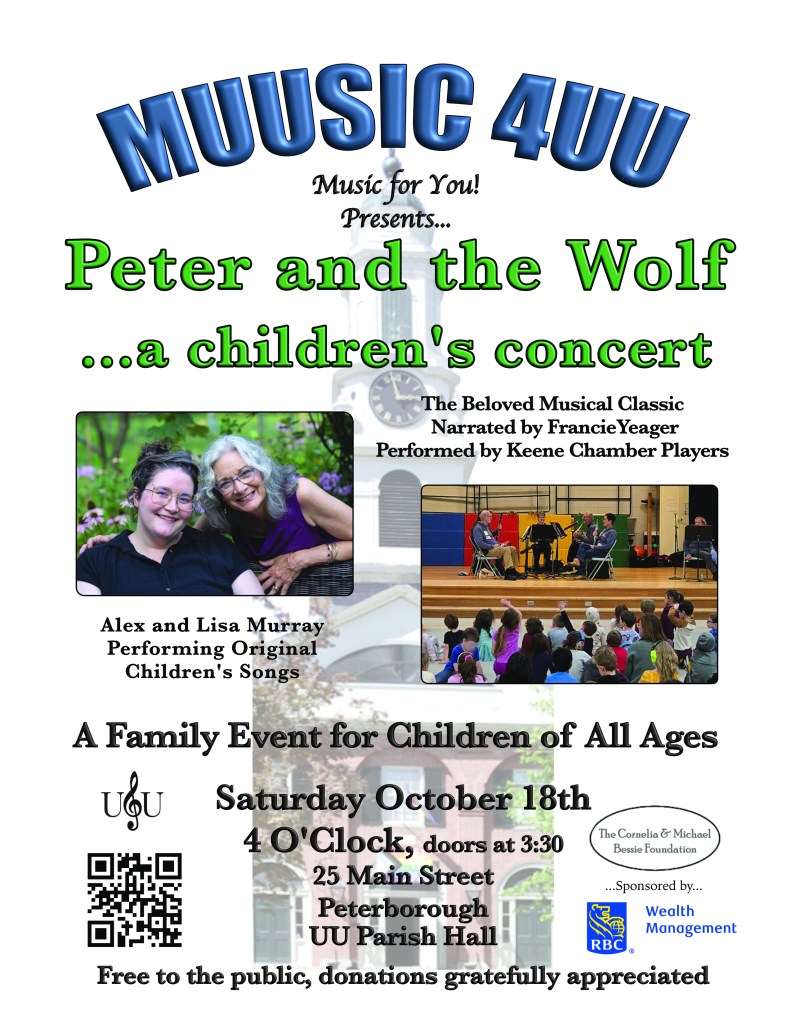
There’s more to Peter and the Wolf than meets the eye. It is by turns, educational, an allegory to Common Virtues, a piece of programmatic minimalist composition, and the kicker – subversive as heck.
The history of how this piece came into being is relevant: Peter and the Wolf was commissioned by the director of a Moscow children’s theatre in 1936. Prokofiev was intrigued by the idea of writing a piece that would introduce children to the different instruments of the orchestra as well as to the concept of leitmotif, or the use of themes to identify character, in a programmatic composition.
He wrote the entire work, libretto and music, in about two weeks. The inside story, perhaps apocryphal, that I always heard from one of my New England Conservatory professors was that Prokofiev composed the leitmotifs without using the piano at all – strictly from the inside of his own ear.
The libretto came about because Prokofiev rejected the poem by a popular author of children’s books, Nina Sakonskaya who, to be fair, had also been commissioned by the aforementioned theatre director. The story goes that Sakonskaya knocked on Prokofiev’s hotel room door, poem in hand, to pitch her story. There is some question whether the composer simply didn’t like the story or whether a door knocked in the night in Stalinist Russia triggered in him existential PTSD such that all further consideration was instantly cast off. Expunged.
But in fact, there was an atmosphere of institutionalized fear in which Peter and the Wolf was created. And it is by pure luck that the work escaped scrutiny and subsequent suppression by Soviet authorities. As it happens, at the time Peter and the Wolf premiered in May of 1936, Dimitri Shostakovich was under fire for his compositions. The Great Terror in the Soviet Union began early in 1936, a time when many composers, writers and artists were imprisoned, killed or disappeared. Shostakovich in particular had been denounced recently due to his opera Lady Macbeth of the Mtsensk District, written and premiered two years before in 1934. This very popular opera was the one that Joseph Stalin had publicly stormed out of in January, putting Shostakovich in the crosshairs of the authorities and causing many citizens to keep a go-bag by the front door. Things went downhill from there.
So Peter and the Wolf was somehow able to run under the radar at a time when works deemed subversive by the party apparatchiks were lit up like fireworks. But maybe a children’s fairy tale of a boy defying his guardian to go play in the forest with his animal friends and encountering a wolf is too innocent to be subversive.
Let’s take a look. According to my sources, in the original poem by Sakonskaya that Prokofiev rejected, Peter was a Russian pioneer, going off to join the Komsomol – the Soviet youth army, much like the Nazi youth forces in Germany during the same time period. Prokofiev’s Petermay be introduced as a pioneer, but his story is one of facing a threat from without. Peter is both rejecting his Bolshevik grandfather and the creeping fascism and totalitarian state. After all, wasn’t the duck disappeared? Is the wolf representative of the threat of Nazi Germany, or the threat from Stalinist Soviet Union? It doesn’t really matter – any child listening will instantly understand an existential threat from a powerful force of destruction. And parents tending that go-bag will look at each other and keep very, very quiet.
Either way, the hunters are there to destroy or contain the wolf – these brave heroes who are there to protect and serve rather than threaten or imprison. In the mind of the child of those times, Western Democracy was always the beacon of hope for peace and freedom. And Prokofiev tapped into that. Perhaps the secret police was preoccupied with capturing bigger fish. But this work is not as apolitical as it appears. Without political trappings, life is about hope, joy, even a jaunt in the sun-drenched fields beyond the fence.
What is more interesting is that not only did Peter and the Wolf escape denunciation, but it nearly simply faded out. It became the world-wide phenomenon it is because of champions in the west in the guise of the Boston Symphony Orchestra and Walt Disney. Prokofiev was allowed to travel to the United States in 1938 and had access to major promoters of arts and entertainment. The BSO recorded the piece in 1939, the Walt Disney short came out in 1946. During that time, performances were scattershot, but it took off post-war and became what it is today.
* * *
Lisa Murray is known about town for her pianistic skills as a teacher, accompanist and sideman. She has been spotted in various churches and theatres in the area and is currently performing regularly with Grove Street.
Her compositional work goes back a number of years, having recorded her delightful folk-rock inflected songs with Eric Blackmer and Charlie Metzler. And her piano works are deep and lush within a minimalist framework; it’s easy to lose oneself in a meditative, peaceful place with the headphones on listening to Lisa’s expressive playing.
Her children’s songs are a relatively recent fork in the road for her, the inspiration for such bubbling forth (her words, aptly enough) from her relationship with her grandchildren. Her partner, Alex Murray, is also her niece, and their musical relationship is relatively recent. Lisa’s gives more depth to the story:
My niece Alex came to visit two years ago from Washington, DC, and started singing one of my original songs that I was playing on the piano. I was reminded of how great her voice is, and asked her to make music with me somehow. We began to ‘meet’ over Zoom and the phone a couple of times a month to write songs and work on music, eventually performing at Porchfest outside of Philadelphia. Alex moved in with me and my husband last March, and we have since done some open mics as well, and a show at the Monadnock Country Club this past summer. Our songwriting has evolved to include children’s songs, spurred on by the first few I had written for my grandchildren. I plan to make videos of these and make them available on YouTube.
The quintet performing Peter and the Wolf and other music this afternoon is an comprised of members of the Keene Chamber Orchestra. Flitting about like a bird on flute is David Flemming, on oboe, the soon-to-be eaten duck is Jodie Hoye, Cora Dykens is sneaky as a cat on clarinet, Joy Flemming provides the essential grumpy grandfather on bassoon, and David Miller comes in from the forest like a wolf on horn. If some of the names seem familiar in our Muusic 4UU circle, you won’t be wrong.
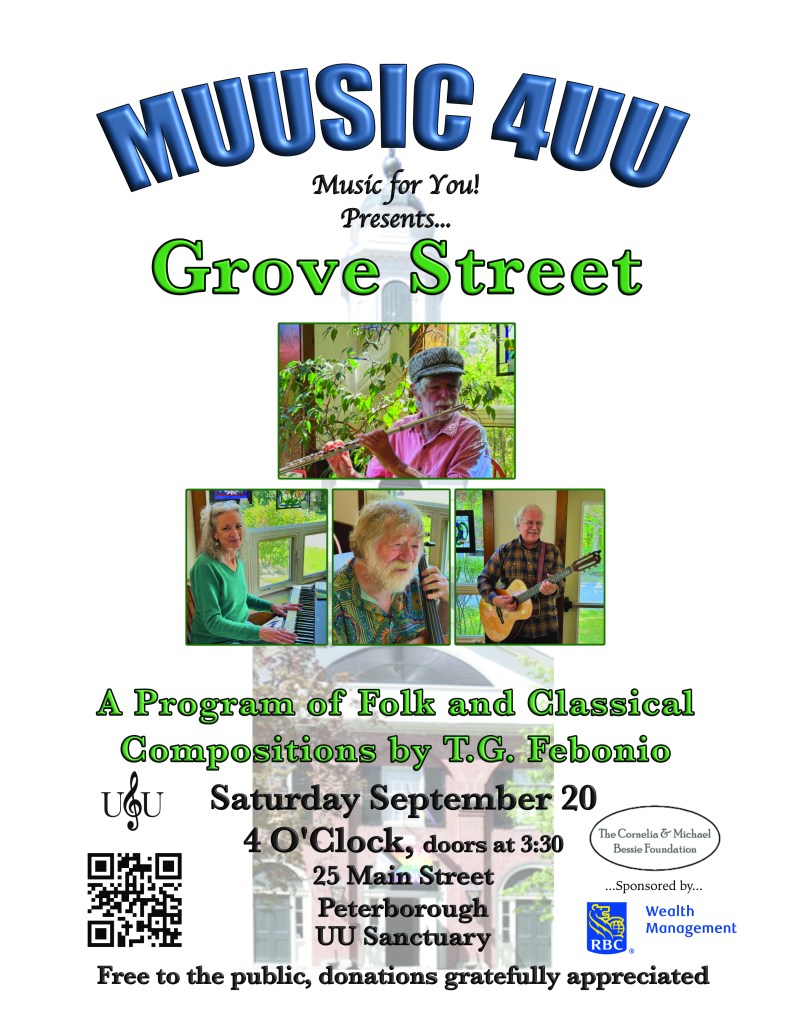
The Grove Street ensemble is one of those musical concatenations that seems to morph on occasion, growing or shrinking with the needs and circumstances of the times or a particular gig. Nevertheless, this group of musicians that play mostly Celtic music (one of the members actually having a claim to Irish heritage!) has been around for quite a number of years, often being seen at the Bagel Mill Cafe, which happens to be on Grove Street in Peterborough (think it’s a coincidence?).
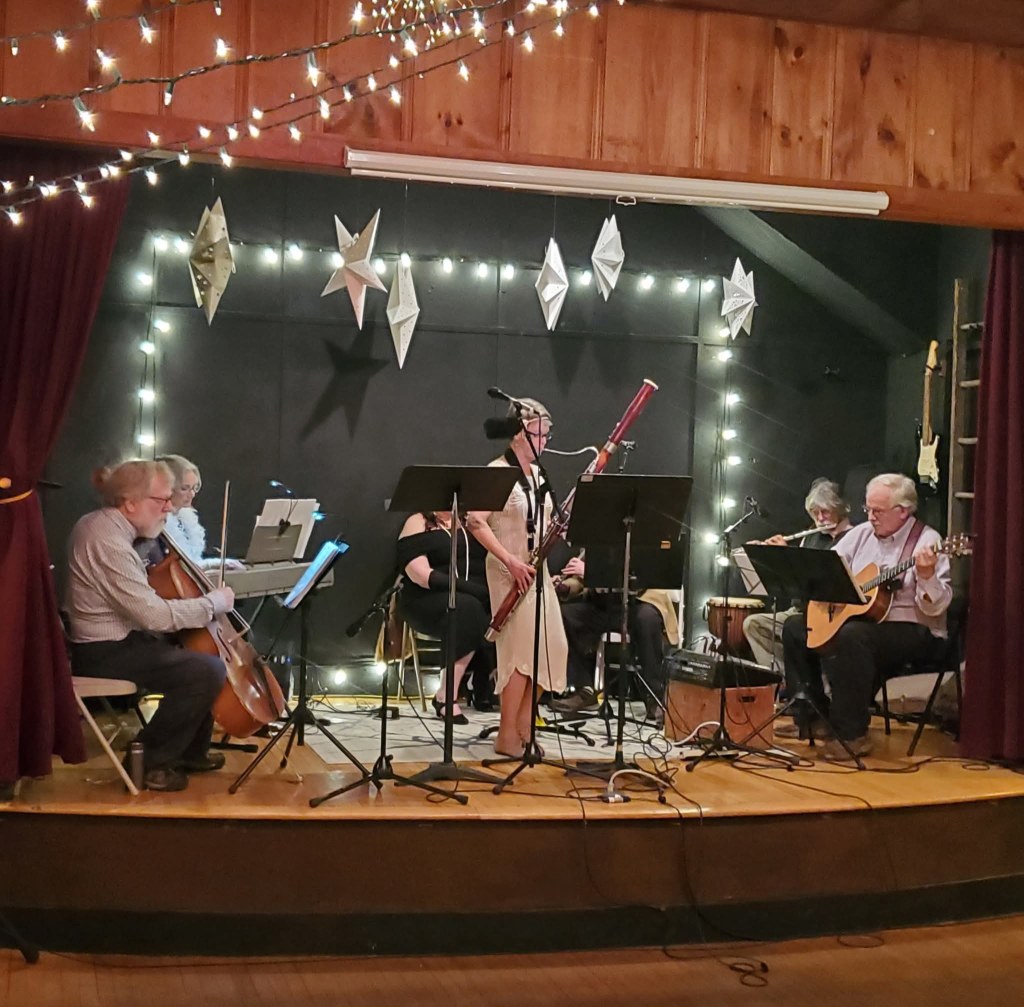
They’ve played for the Muusic 4UU series before — in our first season — and they were wonderful. This time around, they’re featuring mostly tunes by Tom Febonio, but more about him later. First, let’s introduce Grove Street’s members, now as a quartet including pianist Lisa Murray, joining Chaz Beaulieu (flute), Eric Blackmer (guitar), and David Duhon (cello). Chaz and Eric have been playing together for over 15 years in a number of different groups. David joined them about 5 years ago and Lisa, who is quite the gal around town, joined about 2 years ago. Full disclosure: Eric is a member of the committee that organizes the Muusic 4UU concert series.
This concert is themed; most of the works performed in the Muusic 4UU venue are written by composer Tom Febonio. Grove Street became acquainted with the music of Tom Febonio through Chaz, who was pals with Febonio back in college days. But the composer’s work runs through many layers of the Grove Street experience — David was networked into the circle through an appreciated of Febonio’s work, and Chaz is remembered in a number of the composer’s dedications. So, an “official” bio is needed here:
Tom Febonio was born in Salem, Massachusetts in 1950 and began his career in music at the age of sixteen playing electric bass in a rock & roll band. This kept him occupied for about a decade, during which time he took up songwriting and recording, traditional music and jazz. Tom’s compositions to date are mostly tonal and structured along classical or romantic lines, and include solo and chamber pieces for piano, guitar, mandolin, strings and winds. A number of these works are available from ALRY Publications, Forton Music, Guitar Chamber Music Press, Joachim-Trekel-Musikverlag, and VCello Music Publications. He currently resides in Rockport, Mass.
The intersection of traditional, Celtic and jazz is something of a mainstay here at Muusic4UU. Of the tunes you can expect to hear, The End of August is bouncy and jazzy and breaks into improv; Frost Runes has a very Renaissance feel in its simplicity, modality and changing meter. Mrs. Edison’s Rag is straight-ahead ragtime and will have you cakewalking. Her Eyes Were Blue Sometimes Green has a definite bossa feel.
But the tribute to Febonio’s musical depth and intelligence is best said in the words of members of Grove Street:
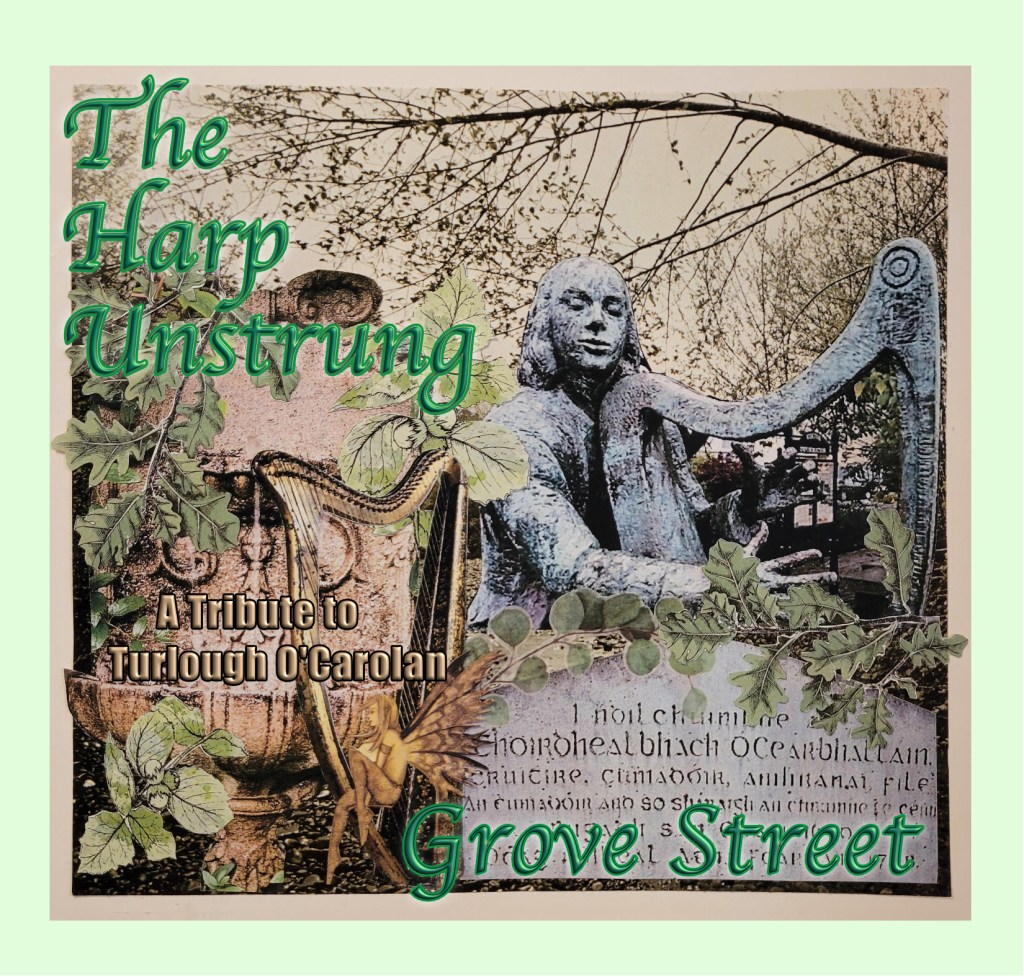
We dearly love Tom Febonio’s work and have been working on a concert featuring his work, as well as a CD of it, for several years. We recently produced a CD called The Harp Unstrung, a tribute to Turlough O’Carolan. We plan to release a similar CD dedicated to Tom Febonio compositions within a year.
I think you’ll love these works as well. Enjoy!
End of August Street Piper Munimula into The Devil Went West Her Eyes Were Blue Scottish Eldorado Freeway Letter from Home /Tundra Dance Her Eyes Were Blue Sometimes Green
Making a living as an artist of any stripe has been difficult in the best of times. We don’t live in a culture that celebrates creativity or creative output in a way that actually supports the artist. Our culture loves having it around, loves going to concerts, relishes the spoils of a craft fair or an art show, but to actually support the producer of these beautiful things …?
But we live in the times we live in. Mozart came out of a system of patronage created by the ruling families of the Austrian court, but rejected (or was rejected by) it evidently finding the effect on his creative freedom chilling. However, Mozart wasn’t a savvy business person – he gambled and lived a high life and died poor. Two other composers did pretty well for themselves – Beethoven, whose years crossed Mozart’s, also shunned aristocratic patronage (which was in decline by that time anyway) but he became something of a rock star for his time and did well. Go back another generation from Mozart and there was J.S. Bach who was a great businessman besides being a brilliant composer. Bach made use of Patronage when it suited him, worked as an 18th century gig worker when it didn’t, and somehow managed to support his two wives and 21 children.
But these days, musicians are subject to something much more oppressive than an aristocracy – we are working in a system controlled by the Music Industry where an artist develops a lucrative career that depends entirely upon airplay and optics that make money for the Music Industry. So how do we support our creative urges?
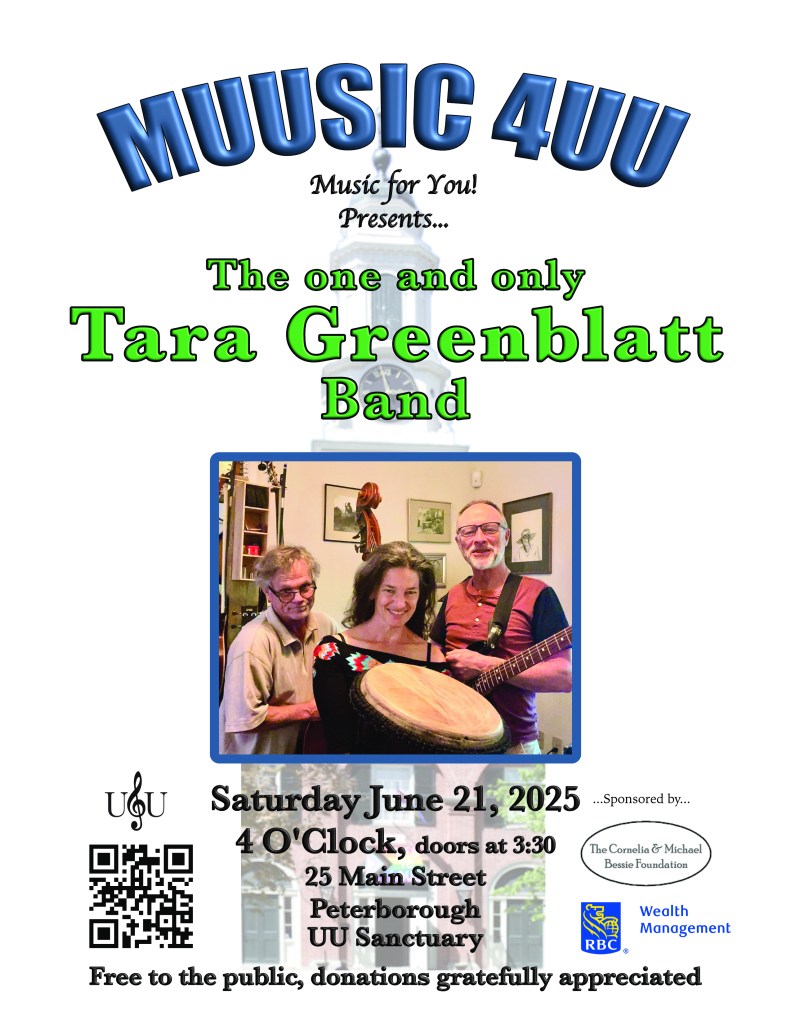
Tara Greenblatt is a musician who has had to configure a life that works for all aspects of her multidisciplinary life. We know her as the drummer and vocalist whose music has “rolling infectious rhythms and a soulful soaring voice alive with the pulse of life.” But we wanted to find out a little more about who the person is, how she has managedto balance creative output with practical need and how her life has morphed with the times. She told me what she is up to, revealing that she’s studying Radiology Tech after some years as Program & Project Manager at River Mead.
That’s where our conversation started:
As you develop new career plans outside of music, how did you come to Radiology?
The first two years after my divorce back in 2020 was for healing and regrouping. The third and fourth years were about figuring out what it will take for me to achieve financial security on my own to see me through to the end of life. I also wanted to position myself someday to: own property, have assets to hand down to my two children, carry health insurance, have money available for unplanned events my kids or I may experience, and some disposable income for travel. I searched for what this would be through a process of elimination for about two years.
Almost every girl has dreams of the future that include the arts, usually along the lines of wanting to be Taylor Swift. For me at age five, I wanted to be a ballerina. How were you drawn to music in your younger years?
Music has been a part of my life all of my life. My Mother raised my sister and I to balance art-making with living life and working. We were very fortunate to have this modelled for us. Now that I am as established musically as I care to be, and since my children are now 16 and 21, there is space for me to dive back into a new career path while keeping connected musically.
Is a dual career something you do out of necessity or as two streams of what you want to do with your working life?
Music is not a revenue stream for me. I don’t consider my music making or performing a career. I have never wanted to position my creativity towards revenue because the pressure and stress of having to produce shuts me down. I actually work well under pressure generally. I can invent a goofy song out of the blue improvisationally, I can riff, come up with ideas impromptu, but that’s when the environment is light weight, uninvested in some kind of product that I or someone else wants or needs to profit off of. Writing songs does need some pressure under it in order to come to fruition, but not the kind where bills, food, or shelter rely on it. I have always been driven by security and stability because there wasn’t much of it in my early years of childhood. Art and creativity are like sacred well springs that a steady job guards the sustenance of.
In busy times, what does your day look like? Any issues with getting time off, are you scrambling to keep all your ducks in a row?
Regular rehearsals are what to tether me to my music. Time management is my friend when it comes to maintaining a healthy balance between work and creativity. I used to work at songwriting and melodies for hours. These last few years and for the next two and half years I have made an agreement with myself to focus mostly on work and school. The music will have to slip through the cracks in the wall. I will have to pay attention, watch the wall for leaks, collect the drippings in fits and starts, and write a little here and there. That is ok. I am making a major life change for the better. I believe a woman should make her own dough, and we have to work hard in this world to create stability.
We sure do! But how do you manage the intersection between “work” life and music life?
I manage the intersection between work and life with a mind set of practicality. I leave my drum set set-up and available, and my writing book near my bed. Pens everywhere. No excuses, the sticks and the drum set are right there in front of me. Even 10 minutes grounds me. I record songs using my voice recorder on the phone. I trust that there will be moments to visit my inner well where songs get made. Ultimately, work is the foundation. When I am financially stable I have the internal space to be creative.
That mind set of practicality – what a resource for any artist of any kind! We all could take a page out of Tara’s notebook. But often for the musician, it’s not about supporting the habit, rather creating good habits that support our music.
* * *
Exploring the world’s most complicated musical instrument
Let’s face it, for many people an Organ Concert is much like an Opera Concert – something for the diehard afficionado. So instead of trying to convince the listener that this is something they have to love because, well, it’s art and you’re supposed to appreciate it, we decided to answer a few questions about the instrument and the music with the idea that with more information you, dear listener, will open your mind and heart to this marvelous sound. I asked around and compiled a list of some basic questions. Read and enjoy!
What is the oldest keyboard instrument?
By all accounts, the organ’s evolutionary precedent is the oldest keyboard instrument. I was surprised by how old it is, dating back to the 3rd century BC with an instrument called the hydraulus. This was a bellows-driven instrument with a bag of air inserted into a basin of water. As the bellows are pumped, the air gets pushed through the water and then exits through a set of pipes. That air is released by wooden levers. Follow the line and you’ll hear it makes quite a pleasant sound.
. Keys were also not always keys, but buttons or wooden plungers that were pushed by the player’s entire hand. Whack-a-mole with musical notes!
How do modern organs work?
All those pipes you see up in the organ loft are set up in groups by sound, or ranks. Each pipe can only play one note, so each rank has a set of pipes equal to the entire keyboard. That’s a lot of pipes! The sound or timbre of each pipe are grouped into ranks partly by their material (wood or metal – in old times that could be lead) and their construction (fipple like a recorder or reed like a clarinet).
What are “Stops?”
Stops are the knobs or levers above or on each side of the keyboard. The term ‘stop’ was one I could never quite wrap my head around, because the act of pulling a stop didn’t seem like you were stopping anything. You aren’t. When you pull a stop you are really opening the stop which allows air into the pipes. So I guess you could call a stop a ‘start,’ which might be a bit more accurate. Stops are called by all kinds of interesting and arcane names, like diapason, bourdon, principal, keraulophon, nazard and tierce, but also more familiar names like flautino, violino and oboe. The stops are generally arranged to associate with different keyboards. Think about the old aphorism: pull out all the stops. You’ve got everything going at once.
Why so many keyboards?
There can be up to five keyboards on an organ, called manuals. Your typical church organ generally has two, sometimes three. The manuals are set to control a specific set of ranks of pipes which kind of answers the question: it’s to give the instrument the widest variety of sounds with plenty of flexibility and ease to move from one sound to another. A good player can make a single piece of music sound like an orchestra (although you can always tell the difference between an orchestra and an organ). Keyboards are generally named Swell and Great, the third keyboard when there is one is generally called the Choir. I don’t know why the manuals are thus named and Wikipedia didn’t help me on that one. Organ keyboards are shorter than a piano keyboard, with about four octaves per manual as opposed to seven on a piano.
What up with those pedals?
More like down with the pedals, but the footboard, or set of pedals, is unique to the organ. It’s set up like a typical keyboard with “white” keys (generally brown) interspersed with black keys just like a piano, only larger. The pedals cover about two octaves (I can’t imagine trying to play four octaves with my feet!) and their sound is in the lowest range of the instrument. So pedals provide the basso profundo part of an organ piece. The pedals are attached to their own ranks in the pipes and there are stops associated with them as well, just not as many. There are also linkages between the keyboard stops and the pedal, so you can get a wide range of timbre and quality of sound coming from the pedals.
Is it hard to play?
Well, a novice definitely starts to feel like a three-armed paper hanger while learning! For me, switching between keyboards was never a problem, although I understand for some it is difficult. If a player has basic proficiency on the piano and is a decent reader, the organ is quite accessible and very fun to play. Pulling the stops can be very tricky, though, because there is a timing issue – closing and pulling four or five stops between sections of a piece of music takes time so there is the hesitation factor to overcome. A player has to have digital expertise (aka fast fingers) or the music sounds jerky. One of the best things about the Hook organ is that in the rebuilding of it they added pre-sets – the organist’s boon. So you set up what stops you want to use to change the sound of a piece of music, hit the pre-set button and voila! all you have to do is push one button as you play and your piece goes on without a hitch.
On the other hand, the pedals are a game changer. Unless you naturally have a lot of coordination, a novice will struggle to perfect Fred Astaire-like fancy footwork. For me personally, I could never sort out what my feet were supposed to do in counter with my left hand. If the pedal notes on the page were written higher than the left hand notes, I could sit for hours trying to figure it out. For most, though, I think it’s about accuracy. You can’t look at your feet (nor should you be looking at either hands or feet — eyes on the music!) so you need to feel the distance between a low C and a D an octave away. So be forgiving when you hear some odd sounds coming from the low end of an organ piece!
Is it different to play from the piano?
Not very in terms of basic reading. Beginning organ music puts the pedal notes on the same staff as the bass clef (left hand). More advanced music gives the pedals its own line, so there’s an expansion of your visual acuity required. But the touch of an organ is quite different and the player has to learn some different technique, mostly around sustaining notes. On the piano you sustain notes with the damper pedal. On the organ, you must sustain notes with your fingers since your feet are playing actual bass lines. This means that the player has to develop a lot of independence between fingers so that some fingers can hold notes while other fingers are playing lines. Most modern organ music is written with this in mind, though, so well-written music sets it up for you. One little bump is that organ keys are just a teensy bit narrower than standard piano keys, so there’s a bit of an adjustment there. Setting stops is immensely fun – you go through a piece to figure out how you want it to sound and the effect you want. Then you jot those stops onto the music and off you go. There’s a lot of artistry in the process of making a piece of music your own.
I hope this gives you, the reader, a little bit of insight into this fascinating and wonderful instrument. Obviously there is a lot more to be said, so I encourage you to discover more. Read about the history and restoration of our Hook organ with this link here.
~Lucinda Ellert
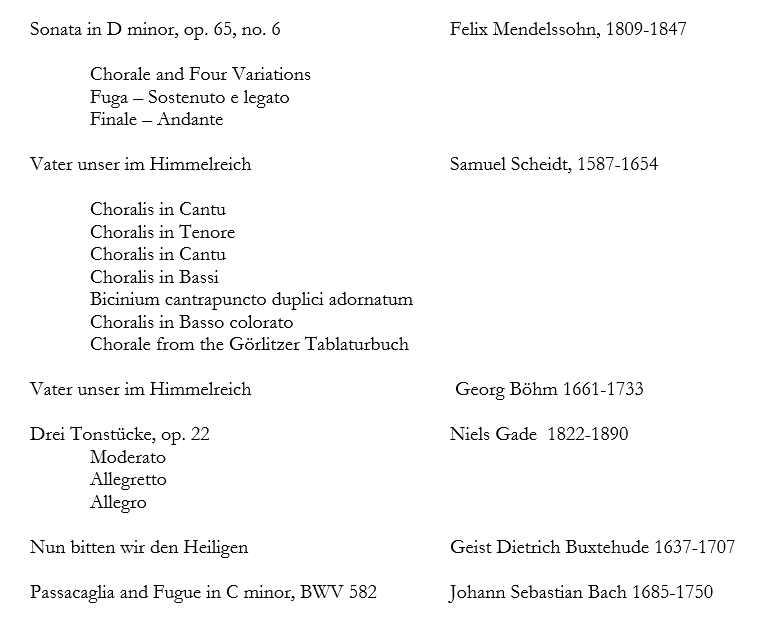
Program
Artist Bio
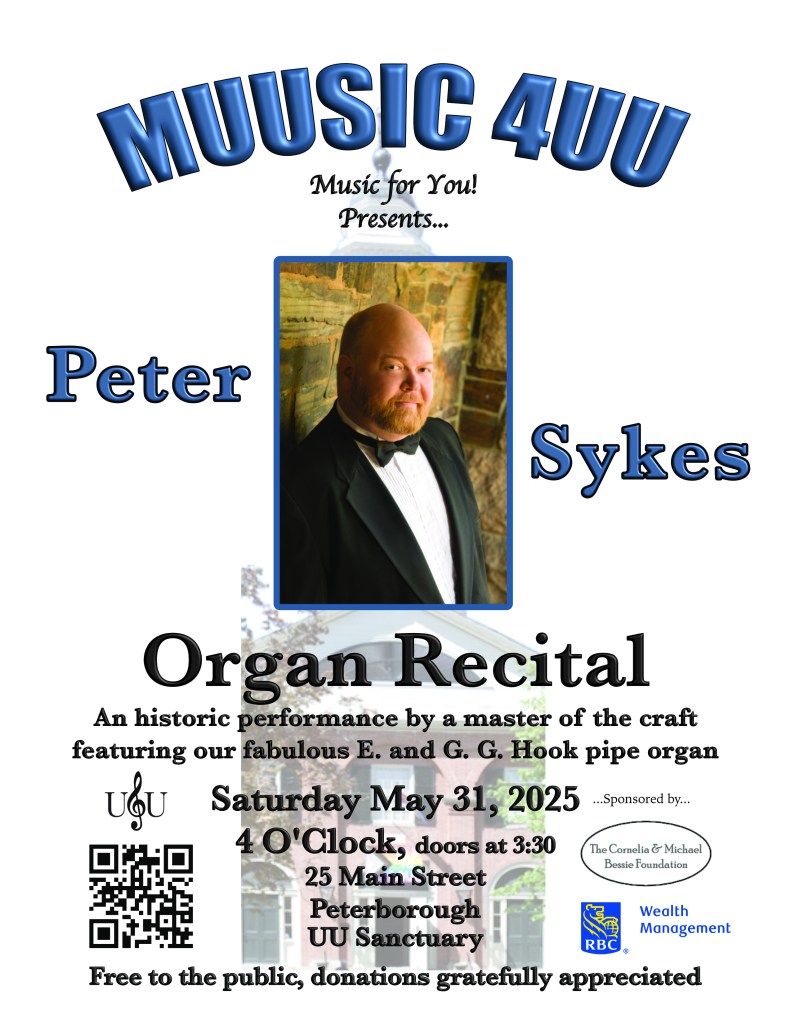
Bio Peter Sykes is a distinguished keyboard artist giving compelling, moving and accurate performances. He gave the opening recital after our organ was restored in 2004.
He holds degrees from the New England Conservatory and Concordia University in Montreal. He won the Chadwick Medal from the New England Conservatory for outstanding undergraduate achievement, and also won the school’s annual concerto competition, playing Frank Martin’s Harpsichord Concerto. His award notifications define him as “A major musical intellect and imagination of our time.”
Peter’s emotive and precise performances have been played internationally. His recordings include works on a variety of keyboard instruments including organ, harpsichord and clavichord.
In demand as a mentor for aspiring professional performers, he is Associate Professor of Music and Chair of the Historical Performance Department at Boston University. In the spring of 2014 he was invited to join the faculty of the Historical Performance Department at the Julliard School of Music as its principal harpsichord instructor. Since 1985 he has served as Director of Music at First Congregational Church in Cambridge. He is Chair of the Organ Library Committee of the Boston Chapter of the American Guild of Organists and has adjudicated competitions sponsored by that Guild, the Royal Canadian College of Organists, the Bach International Harpsichord Festival in Montreal, the Broadwood Harpsichord Competition in London and the Miami International Organ Competition. As a member of the board of the Cambridge Society for Early Music, he is a founding board member and current president of the Boston Clavichord Society.
* * *
Divine Speech: Music and the Language of Community
An eleven-year-old boy living in Florida takes an interest in playing the guitar after hearing a record album of Andrés Segovia; his parents gift him an instrument along with lessons and soon thereafter, just months really, this child has acquired enough skill and repertoire to perform an entire concert from memory.
This kind of thing doesn’t seem to happen that much any more — at least we don’t hear about it as much. But the intense need to communicate using a language other than speech — in this case music — has always existed in our species.
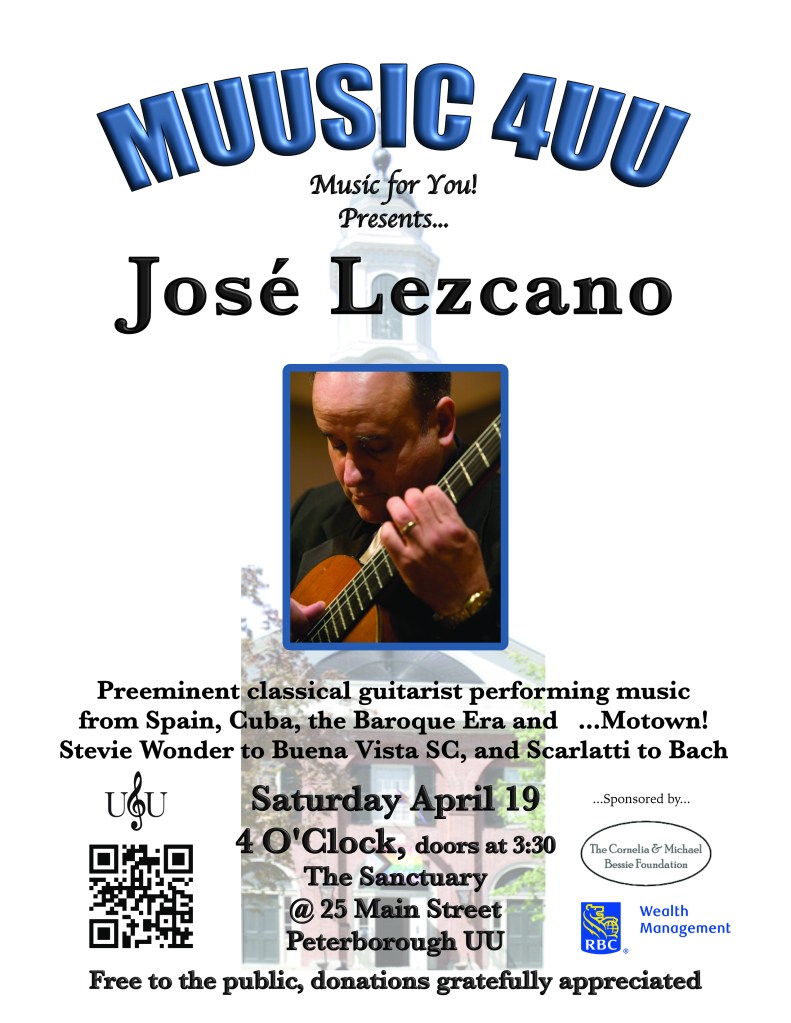
José Lezcano was just that Florida child and his music still speaks volumes to this day. His accolades are a matter of record: visit his website to read about his grammy nominations, awards and his fascinating concert/lecture series. But the real modus operandi of this musician is the passion with which he lives, breathes, shares and speaks the language of the guitar. That language includes stories — the histories, canticles and poetry of the instrument and his own stories of his career. Even the recounting of that first concert (“I got a standing ovation and I said to myself, this is what I want to do.”) speaks of a yearning to communicate an enthusiasm that is as much spiritual as it is prosaic.
The polyglot nature of Lezcano’s approach to music extends to his programming. On one hand he gives a description of the sometimes raucous Ecuadorian Cayambe with such love, but then programs Stevie Wonder’s gentle, jazzy Overjoyed. It may seem that the two don’t share enough in common to find mutual understanding. But Overjoyed with all its complex harmonic structure and serpentine melody played as a bossa makes perfect sense with Cayambe guitars that were created by jerry-rigging the instruments with added strings and odd tunings, initially done as a form of protest against the Spanish Inquisition.
In learning about Lezcano’s choices for this program I discovered that Dominico Scarlatti, that Italian baroque composer that wrote grand masses with orchestra and chorus also wrote delicate guitar solo works with a distinctively Spanish rhythm. These and the self effacing humor of Brazilian love songs against sad melodies bring together a sense of the way music manages to convey a connection that tells a story with a deep message: because of inherent disagreement between form and function, because there is contrast between high and low art that can be alarming, this is who we are as a people.
During my research, I came across an interview that Lezcano did with the Keene Sentinel some years back. He spoke of how deep music goes to the very heart of us: “Music is a divine speech,” he said. I asked him how he hoped to provide Sanctuary in our Sanctuary, given the current mood of the times. His reply: “What we learned during the pandemic is that music provides community and solace and makes us feel less lonely. If you play happy music it lifts your spirits, if you’re feeling sad, it makes you feel better.”
Isn’t that why we’re here? To commune with something greater than ourselves and improve our lot in the process?
Program
“Music from Spain, Cuba, Brazil, the Baroque, and Motown”
Overjoyed Stevie Wonder (b. 1950) arr. Lezcano
Capricho Arabe Francisco Tárrega (1852 – 1909)
Sonata K. 178 Domenico Scarlatti (1685 – 1757)
From the First Cello Suite, BWV 1007 J.S. Bach (1685 – 1750)
Prelude
Sarabande
Courante
Sonata K. 11 Domenico Scarlatti (1685 – 1757)
Three Cuban Contradanzas (1890) Ignacio Cervantes (1847 – 1905)
El Velorio (The Wake)
Adios a Cuba (Farewell to Cuba)
Los Tres Golpes (The Three Knocks)
Variations on a theme by Mozart, op. 9 Fernando Sor (1778 – 1839)
Intermission
Etude no. 1 in E minor Heitor Villa-Lobos (1887 – 1959)
Si Ela Perguntar Dilermando Reis (1916 – 1977)
Buena Vista Social Club Suite, arr. José Lezcano
Chan-chan Compay Segundo (1907 – 2003)
Dos Gardenias Isolina Carillo (1907 – 1996)
Veinte Años Maria Teresa Vera (1895 – 1965)
Bolero Manaba José Manuel Lezcano (b. 1960)
Serenata Española Joaquin Malats (1872 – 1912)
***
Spring 2025 schedule:
March 15, 2025 Decatur Creek
April 19, 2025 José Lezcano – Classical Guitarist, Grammy-nominated performer, Keene State College Faculty
May 31, 2025 Peter Sykes – Hear our magnificent Organ played by this stellar performer!
June 21, 2025 Tara Greenblatt
Converging Sources
The water flowing over the dam next to our house tells us that spring is underway. The source waters are Potato Creek on the northeast side of Stoddard Pond; once it crosses the spillway it becomes Beaman Brook. Spring is such a noisy time, especially coming out of the deep quiet of winter. No birds, no brook, waters frozen. Music is the best way to break up the silence, to bring some life back to us – music from many waters, many sources …
I log on to my YouTube channel and pause a moment by the source waters of Decatur Creek, sitting back and listening to the waters of New Hampshire. I hear a gently rocking fiddle floating on sweet melodies, sparkling jangles of guitar and mandolin penetrating through a constant undercurrent of harmonies and gentle voices murmuring, amplified over the water.
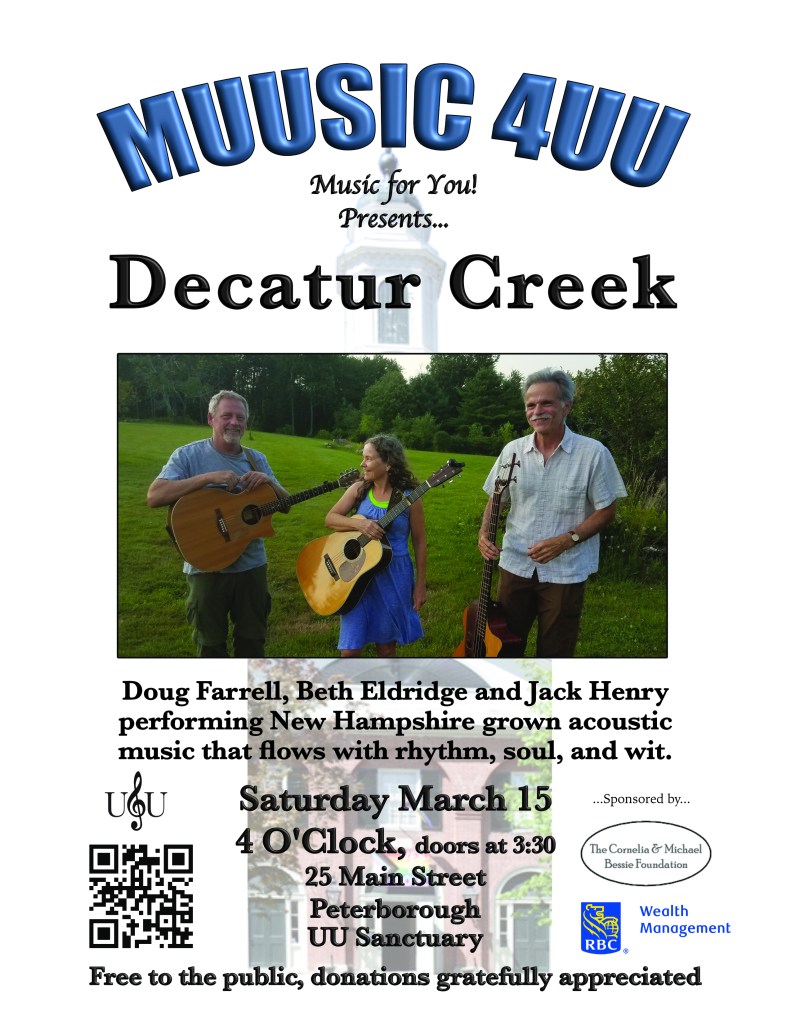
If there is a waterway named Decatur Creek someplace in New Hampshire or elsewhere, Google Maps is keeping that secret. I’ve heard through the grapevine that one of the band members had a creek of the same name running near his childhood home in upstate New York. Doug Farrell, Beth Eldridge and Jack Henry are the visionaries of Decatur Creek, and it is their unique and individual experiences that provide the bedrock.
So, the band is itself a confluence.
Doug Farrell, the band’s leader and singer/songwriter, has been on the scene for some time. Living in New Hampshire since the 90’s, he has been seen frequently in coffeehouses, festivals and on NHPR’s “The Folk Show.” While not writing or making music, he has a carpentry/cabinetmaking business and has also had some light shone on him more than once as a finalist and a winner in the New England Songwriting Competition. Some words off his website:
Doug’s songwriting is shaped by his artisan carpenter eye, the ear of a poet, and the heart of an artist. His songs, ranging from humorous to dark, are simple yet deceptively layered with nuance, wit, and substance that render them easy to hear and hard to forget.
Beth Eldridge is a Massachusetts native, hailing from Westborough and now living in about as central New Hampshire as you can get. Her musical training was “informal” by all accounts, playing guitar early on until she had the unparalleled opportunity to study fiddle with the great Alan Block, impresario of Celtic-influenced New England contra dance music in addition to Appalachian tunes. As an alumna of the now-defunct Bradford Bog People, her style of playing is solidly backwoods, pure and authentic. Good clogging music!
Jack H. Carleton grew up in Massachusetts, the child of a musical family, so the gigging lifestyle is not at all unfamiliar to him. However much he came to the “biz” as a natural, he took a more practical (and lucrative) route with a career in finance; after a gig-scouting trip to Nashville he discovered just how difficult it is to carve a path in music full time – our good fortune that we got him instead of Tennessee. His bass playing is so solid and resonant – the perfect foundation for music — perhaps we can continue the analogy and call it the aquafer.
Here is a little history on the Decatur Creek you see today (Jack speaking):
Doug and I had met in the early 2000’s at local coffeehouses and kept saying we should get together. But between work, family, school, etc. it just never quite happened. In 2011 I bought myself an acoustic bass for Christmas and showed up that spring at the Round Room coffeehouse in Mont Vernon and persuaded Doug to play for a bit. I didn’t know he had just partnered with another singer-songwriter (Steve Dionne) and had booked a gig, but got Steve to agree we 3 should get together and see. After about 20 minutes of playing together, Doug asked Steve “So, what do you think about Jack playing with us?” Steve replied, “I don’t want to play without him”! The feeling was mutual; we all quickly recognized the chemistry and Decatur Creek was formed. At Doug’s suggestion, Beth sat in and played with us on the side as the unique sole fitting addition. She continued to gig with her band The Bradford Bog People until they disbanded a few years later and she came on full-time with DC. Steve left the band in 2019 and the three of us have carried on since.
This blog has spoken previously about the rise of Americana – the genre of music which is itself a tangle of streams and tributaries. When I asked them individually about what musicians/groups had their greatest influence upon their playing, I received quite the range: Crosby, Stills, Nash and Young rose to the top of the list, but followed closely by other standard-bearers of Appalachian/Country music, including Merle Haggard, Gordon Lightfoot, Emmylou Harris, Willie Nelson, Waylon Jennings. But the singer-songwriter aspect is strong: Cat Stevens, Joni Mitchell, James Taylor, Bob Dylan. But coming from the other direction are greats among the rock genre: Allman Brothers, Little Feat, the Beatles and even Jimi Hendrix. And along the way kiddie pop group The Banana Splits are mentioned (Ok that was a youthful indiscretion. I confess to being in love with the Monkees.)
We’re clearly at a time when all our streams of music converge into the mighty river of American Music. As Jack Henry puts it, it’s all about “beautifully crafted songs, honest voices and playing that resonates.”
***
March 15, 2025 Decatur Creek
April 19, 2025 José Lezcano – Classical Guitarist, Grammy-nominated performer, Keene State College Faculty
May 31, 2025 Peter Sykes – Hear our magnificent Organ played by this stellar performer!
Angels We Have Heard on High – arr. Martha Lynn Thompson
The Holly and the Ivy – Traditional British Carol, collect by Cecil Sharp
Patchwork Christmas – arr. by Karen Buckwalter
Brass
And the Glory of the Lord – G.F. Handel arr. Thomas
Christmas Jazz Suite – Bill Holcombe
Bells
Carol of the Bells – by Peter J. Wilhousky
I Wonder as I Wander – Appalachian Carol, collected by John Jacob Niles
Brass
Just a Closer Walk With Thee – arr. Jack Gale
Three Christmas Quartets – arr. John Beyrent
Simple Gifts Arr. David R. Thomas
Bells
Deck the Hall – Traditional Welsh Carol
Go, Tell it on the Mountain – African American Spiritual
Brass
Holiday Sing Along!
* * *
Program notes:
With the glint of shiny brass, and the colors of Christmas, the experience of the sight and sound of handbell choir and brass ensemble is at once festive and thrilling. Keene United Church of Christ Ringers on the Square join with the Muusic 4UUCelestial Brass Ensemble for our second annual joyous holiday themed concert in the Peterborough Unitarian Universalist Sanctuary. Holiday favorites and a community sing along round out the program.
Ringers on the Square has been ringing handbells at the UCC in Keene, NH for over 40 years, and is led by Diantha Dorman. Diantha, a pianist and organist in addition to Bell Choir Director, has been leading two bell choirs at the UCC in Keene for over 20 years.
This concert will be a “rare public appearance outside of church” for the group. The 13 ringers play 5 Octaves (that’s 61 bells) of Schulmerich English Handbells. The bells, made in Pennsylvania, range from the lowest, at 7 pounds, to tiny, higher pitched ones. While the larger bells definitely require some brawn to heft, the tiny bells are frequently played “two in hand” by skilled ringers who can ring up to four bells at once.
The multiple ways to sound the bells (ringing, hitting with mallets, tapping on the tables, and swinging) and the light and airy sounds of chimes all enhance the ethereal quality of the group’s sound.
A brass ensemble can come in various sizes, from a trio to a large all-brass band, but a quartet or quintet is somewhat the standard for a brass choir. There is tons of music written for this conformation – think “Canadian Brass” who for years has written, arranged and performed brass choir music resulting in (more or less) the canon for modern brass music. And among the best music is written for the holidays – cleverly arranged for smaller ensembles. The Muusic 4UU Celestial Brass Ensemble includes Sheldon Ross and Vincent Destefano on trumpets, David Sworny, trombone, and Dan Walker on euphonium/trombone.
Singalong Lyrics
O Come All Ye Faithful
O come, all ye faithful, joyful and triumphant O come ye, o come ye to Bethlehem O come and behold Him, born the King of Angels
O come, let us adore Him … Christ the Lord
O sing, choirs of angels, sing in exultation O come, o come ye to Bethlehem O come and behold Him, born the King of Angels
O come, let us adore Him … Christ the Lord.
Joy to the World
Joy to the world, the Lord is come Let earth receive her King Let every heart prepare Him room And Heaven and nature sing And Heaven and nature sing And Heaven, and Heaven, and nature sing
He rules the world with truth and grace And makes the nations prove The glories of His righteousness And wonders of His love And wonders of His love And wonders, wonders, of His love
O Little Town of Bethlehem
O little town of Bethlehem How still we see thee lie Above thy deep and dreamless sleep The silent stars go by Yet in thy dark streets shineth The everlasting light The hopes and fears of all the years Are met in thee tonight
For Christ is born of Mary And gathered all above While mortals sleep, the angels keep Their watch of wondering love
O morning stars together Proclaim thy holy birth And praises sing to God the King And peace to men on earth
Angels We Have Heard on High
Angels we have heard on high, sweetly singing o’er the plains, and the mountains in reply echoing their joyous strains:
Refrain: Gloria, in excelsis Deo! Gloria, in excelsis Deo
Shepherds, why this jubilee? Why your joyous strains prolong? What the gladsome tidings be which inspire your heav’nly song? [Refrain]
Jingle bells, jingle bells Jingle all the way Oh, what fun it is to ride In a one-horse open sleigh, hey Jingle bells, jingle bells Jingle all the way Oh, what fun it is to ride In a one-horse open sleigh
Jingle bells, jingle bells Jingle all the way Oh, what fun it is to ride In a one-horse open sleigh, hey Jingle bells, jingle bells Jingle all the way Oh, what fun it is to ride In a one-horse open sleigh
Silent Night
Silent night, holy night! All is calm, all is bright. Round yon Virgin, Mother and Child. Holy infant so tender and mild, Sleep in heavenly peace, Sleep in heavenly peace
Silent night, holy night! Shepherds quake at the sight. Glories stream from heaven afar Heavenly hosts sing Alleluia, Christ the Savior is born! Christ the Savior is born
Silent night, holy night! Son of God love’s pure light. Radiant beams from Thy holy face With dawn of redeeming grace, Jesus Lord, at Thy birth
Jesus Lord, at Thy birth
A Warm and Loving Holiday Season to Everyone!
* * *
November 16, 2024, Piano Extravaganza
The Extravagance of Hammers and Strings
Tony Brinsdon and Beethoven
Program
Ludwig van Beethoven
Piano Sonata No. 7 in D major, Op. 10, No. 3
Presto
Largo e mesto
Minuet
Rondo
Tony Brinsdon, a gentle man and a fixture of Peterborough Unitarian Universalist Congregation, is also a quiet genius on the piano. He began his musical career at the age of five in Bristol, England. He was educated at Cambridge University and came to the United States in 1978, working in corporate accounting and finance in manufacturing companies, at some point living and working in France for six years. Since his retirement to the Monadnock region, he has studied with internationally renowned collaborative pianist, Vladimir Odinokikh, a teacher at Keene State University and Franklin Pierce College.
Tony is studious and very focused. He has been very much a part of PUUC operations and finance, but has still been part of the musical life of the congregation, giving recitals and accompanying choir and soloists when needed. The measure of the man is in his fondest memory: that of participating in his children’s efforts to learn a second language during their years in France.
The Sonata No. 7 was written in 1798, making it one Beethoven’s earlier works. He dedicated the sonata to the Countess Anne Margarete von Browne. This makes it contemporary with his three Op. 9 string trios, his three Op. 12 violin sonatas, and the violin and orchestra romance that later became his Op. 50 upon its publication.
* * *
An Original in Her Own Right: Marybeth Hallinan
Program
Selections to be announced
Original compositions by Marybeth Hallinan
Marybeth Hallinan is one of those freelance musicians that the rest of us dream of becoming. As a teacher, mentor, composer, performer, music director, and trail guide for musicians, she fills a keystone position in two communities: the general public and the strong and vibrant musical community of the Monadnock area. Her lesson studio for piano and voice students has been a fixture for thirty years and she is a familiar presence locally as accompanist for local school choir concerts and other musical events.
Building a career in music is a real two-step for musicians. Marybeth has accomplished this masterfully; her stability in the choral scene comes from a long term post at the Peterborough Unitarian Universalist Congregation and with a community choir she founded and directed. As a composer, she has established a presence both locally and online; her songs are gentle and soulful, her voice warm and earthy. She has crafted many poignant compositions around themes of love, loss, grief, joy, community, and spirit.
This fits the artist and her approach to life, and there is so much more to that than just directing a choir or giving a piano lesson. To Marybeth, music is the essence of healing the whole person. When not teaching or accompanying, she leads a hiking and singing camp for adults, “Sound Adventures,” and offers workshops and sessions, “Sound Healing for Sound Health” through her businessFundamentally Harmonic. As she puts it:
Music’s innate ability to bring people together and to heal have led me naturally to a place of intentional healing through sound. I am passionate about assisting others to return to their own fundamentally harmonic self.
This approach comes through her performances, building her sets around what the moment might need. She considers “how best to serve that moment through the arc of the songs. A gentle beginning, provocative middle, and hopeful resolve.” That sounds pretty much like her compositions.
With a career that weaves such a rich tapestry, she has found the ideal way to offer herself to our world. Of this tapestry, she says:
These threads are woven from the depth of heart connection with the natural world, with sound and vibration as a healing modality, and the skills I arrived with in this world. They are a collective as an outpouring born from my experience. Most of these colorful threads found their way to my tapestry on their own. I follow the threads!
What a beautiful idea…
* * *
The Incomparable Virginia Eskin
Program
Frederick Chopin
Fantasy Impromptu, “Aeolian Harp” Etude
Revolutionary Etude, Op 25
Joseph Lamb
Ragtime Nightingale
Scott Joplin
Mexican Serenade
Franz Liszt
Liebestraume, Valse Oubliee
Ludwig van Beethoven
Sonata quasi una fantasia “Moonlight,” Op 27
One of the most delicious aspects of living and working in the Monadnock region is that, due to the area’s wealth of the Arts, many world class artists come here to retire! Yes, Virginia Eskin is indeed a world class artist; a boilerplate bio puts it this way: Virginia has performed all over the world and on national radio and television. She created and hosted “First Ladies of Music,” winner of the Clarion Award in 2007. A regular with the Boston Symphony Orchestra, she has traveled the world over in the capacity of a soloist and concerto artist.
This is all true, but so narrow a vision. For starters, Virginia is such an interesting entertainer! I asked a few questions of her and received a wealth of information worthy of a full biographical sketch. In the interest of this blog, I’ll give you the highlights.
When speaking informally to a major figure, it seems uncharitable to reduce such a presence to a resume of performances – in any event, impossible to list thousands of appearances in the manner of Wikipedia. Moments of conversations of luminaries in their field engenders the best of stories – the fact that she enumerated her Symphony Hall appearances (26), the conductors she worked with (Arthur Fiedler, Harry Ellis Dickson, and John Williams at the top of the list).
My favorite story is also hers, and one that speaks so eloquently of the connection to tradition that musicians share. In her words, which I paraphrase:
The highlight of my career was playing in Carnegie Hall with the Boston Symphony Orchestra … playing on that fabled stage, looking down at the knotholes in the floorboards, and realizing I am sitting in the exact spot that Arthur Rubinstein and Vladimir Horowitz once sat in.
This sense of awe and wonder is an illumination of another Virginia-ism. Asked about early developments in her career, she thought back to younger days and revealed what it is to be an emerging artist:
Well, we never stop emerging really. Musicians are magpies and constantly pick up ideas, themes, modulations, chord changes, anything to improve, enhance our sound.
So, music keeps us growing, then. Seeing something develop in our children, watching students become aware and enlightened or people healing, discovering oneself on the front lines of making Tradition: What comes from a relatively simple analog musical instrument of keys and strings, dampers and hammers, has so much to do with the person touching those keys and bringing themselves to the music.
~Lucinda Ellert
* * *
Just What the Heck is Americana?
Styles of music go through cycles – not exactly a birth/life/death cycle as organic entities experience – but something more like recombinant DNA. Each new period of music has its creators, followers and adherents, which then segues gradually toward a new period with new creators and followers who all borrow from past styles and move forward. The building blocks of one period – i.e. DNA – provides the foundation for something new.
Consider the segue between the Classical and Romantic periods – Mozart to Beethoven comes to mind. Mozart wrote at the pinnacle of the Classic period in a manner that shouts logic to our ears. Beethoven, whose lifetime crossed Mozart’s by about 20 years wrote in a style similar to Mozart’s until around 1800 when he began to depart from the Classical period by degrees, pioneering early Romanticism which gave rise to the greatness of the symphonic music of the 19th century. That period in the late 1700’s to the first decade or so of the 1800’s, which featured many great works of music but which is largely overshadowed by Beethoven’s early symphonies is just such a segue.
This may seem to have nothing to do with the Muusic4UU concert of Americana with Jonas Taub and Off the Cuff, but keep reading and I’ll bring it around for you. Here is the Wikipedia definition of Americana:
Americana (also known as American roots music) is an amalgam of American music formed by the confluence of the shared and varied traditions that make up the musical ethos of the United States of America, with particular emphasis on music historically developed in the American South.
The word amalgam is important in this context. We are all familiar with the different approaches to music in our lifetimes: Jazz, Blues, Swing, Folk, Bluegrass. Also Country, Soul, Gospel and we mustn’t forget rock and roll. Americana is what is now being defined, in some words, as the “rich threads”1 all being woven together into a tapestry.
When I asked Jonas Taub to name five words that come to mind when he considers the music played by Off the Cuff, those first five above (Jazz, Blues, Swing, Folk and Bluegrass in that order) were where he started. I asked him to explain them in order of importance:
“This is a list of musical style that are part of our repertoire. No one is more important than the others. As our PR materials state, we are an acoustic band performing different styles of American Music, Americana, if you like. But Americana often refers to music that draws from folk/country/bluegrass/traditional influences. We define Americana more broadly to reference the influences of jazz, blues, swing, soul, R&B “The Great American Songbook” and musical theater, as well as traditional and modern folk, rock, country, bluegrass and other roots music. “
So for the purposes of an Off the Cuff concert, there is no order of importance. And that’s what’s important.
What I’m hearing is a combination of standard tunes with a predominantly folk instrumentation, but sometimes electronically amplified. Vocals are often tight trios a la 1940’s Swing or 1970’s rock, but there are also descanted duos with interesting harmonies in fourths and fifths in the style of folk and country. The addition of clarinet becomes a stand-in for a whole host of higher tessatura instruments like the harmonica, but also improvises in a way that hearkens back to Pee Wee Russell or Barney Bigard.
A tune like If It Hadn’t Been for Love has a feel much like the Neil Young or Eric Clapton unplugged concerts and recordings of the 90’s, but with clarinet filling in the harmonica licks. Likewise, Wake Up Little Suzie, that iconic Buddy Holly early rock standard, is transformed into a solid blues approach reminiscent of Blind Lemon Jefferson. But the versatility is clearly their liveliest calling card – they can play Pennies From Heaven in a very typical Traditional Jazz style as easily as they can channel Joan Baez in Red Skies.
Jonas puts it this way:
Ray Charles was once asked if he considers himself a Jazz musician. He answered that he considers himself an R&B musician who sings jazz songs. In that sense, we are a folk group that sings jazz songs, blues, bluegrass, and all the rest of what I listed. We would no more be considered a jazz group than a bluegrass group, but we try to bring some authenticity to each song and add our own personal touch.
It’s impossible to not get excited by this musical movement. This tells us that not only is the evolution of music not dead, but that there are new things on the horizon. If the timeline of music has a tendency to morph — an inexorable recombining of DNA – then we are on the brink of yet more change toward new sounds to delight and deepen our cultural heritage. In the meantime I’m just going to sit back and enjoy hearing all my favorite old tunes presented in such refreshing ways. Off the Cuff may seem to be something that is casually tossed out to us, but it really is a balsam for the American soul.
Wendy Keith is an award winning singer songwriter with roots in Boston and a long and musical life in and around the Monadnock Region. She has recorded four LP original recordings, the most recent of which is It’s About Time with her Alleged Band. Wendy will be playing with acoustic bass player and friend, Ramsey Thomas and friends, an accumulation of original, Americana, blues and jazz. She has played at the Folkway, the Colonial Theatre, and other regional venues. She has opened for the band America and for Jesse Colin Young.
Ms. Keith is an essentialist – as essential as afternoon tea. She writes from her core and sings from her heart. Warm and earthy, her music is the ground beneath us: a foundation. That foundation is solidified by her co-players for this concert: Ramsey Thomas and Walden Whitman
With a name that is literary from all vantage points, Walden Whitman is a poet and a naturalist of music. His basis is wide – saxophone, clarinet, flute and penny whistle are his instruments, but he sings in a warm gospel baritone and picks up the Celtic harp as needed. In my mind, Celtic harp, flute and pennywhistle in a folk band is like jelly with peanut butter or clotted cream with our biscuit. Adding saxophone is a real game changer with a whole new performance practice and inflection in the music. Sax brings the wail to the blues, the edge to the folk and invites jazz into what would otherwise be a polite tea party.
Ramsey Thomas is one of those musicians who stands at the back of the band, seemingly innocuous and without a lot of flash and bang. But for our tea party, his smooth, deep and resonant sound on his acoustic string bass is literally the cream in the cup. You may not so easily find him all over YouTube or Facebook as a soloist, but you will never forget that incredible sound. He is a veteran of many years with the Folksoul band with fellow musicians Fred Simmons, Leslie Vogel, Tara Greenblatt, and of course Walden Whitman playing an enticing mix of folk, blues and jazz.
I asked Wendy if they planned on changing up any of their repertoire for this concert and she said:
We intend to play originals, some familiar and some new. We will be adding blues, jazz, Americana favorites and I’m excited about the freedom to explore with this particular trio. Last year we focused a great deal on jazz and added some vocal harmonies with new personnel. I have worked with Walden for years and recently began to work with Ramsey on bass, particularly at a very successful blues show with Skip Philbrick on the Hancock common.
Well, I don’t know about you, but I can’t wait to hear.
FALL 2024
Sept. 21 Wendy Keith
Oct. 19 Off the Cuff (Jonas Taub)
Nov. 16 Piano Extravaganza with Tony Brinsdon Beethoven Sonata Op 10 No. 3; Virginia Eskin, and others
Dec. 14 Bells and Brass – Keene United Church of Christ Ringers on the Square and Celestial Brass
SPRING 2025
March 15, 2025 To Be Announced
April 19, 2025 José Lezcano – Classical Guitarist, Grammy-nominated performer, Keene State College Faculty
May 31, 2025 Peter Sykes – Hear our magnificent Organ played by this stellar performer!
June 21, 2025 To Be Announced
Welcome to the Muusic 4UU Blogsite! We’re planning Season Three and because we’re so excited about our success of Season Two we’re really stoked about our plans for a new series of concerts for fall of 2024 and spring of 2025. It’s always so great to see something that has been created take flight, but the real success is in the followers and supporters that get on board with us, the creative team.
Soooo, if you are reading this, you are either one of those supporters, or you just got here because you found the QR code on one of our posters or postcards and scanned it. If you are in the former camp
THANK YOU!!!
If you’re a newcomer to Muusic 4UU: WELCOME!
Here you will find all the information you need to know (or ever hope to!) about all our performances that we present throughout a season. We will add all the program and performer information for each concert as it comes up, so you may have to scroll down a bit to find the one you are currently attending. But just think, almost no paper waste, low printing costs, and information that can be archived and still available for all time … we’re green, baby!
WHO ARE WE?
We are all part of a community of musicians and music lovers who live and work in the Peterborough, NH area; some of whom attend the Peterborough Unitarian Universalist Church (hence the proliferation of UU in our logo!). Coming out of the pandemic and seeing an opportunity to bring back live music, we organize and promote two half-seasons of concerts to help bring more music and joy into the world. Our performers are professionals — local and regional and our groove is uh, shall we say diverse? From folk and jazz, to blues and country, to classical and opera — our plan is to keep it interesting and representative of who we are in our musical souls up here in Peterborough, New Hampshire.
Muusic 4UU is sponsored by The Bessie Foundation and RBC Wealth Management.
A Concert of Art Song and Lieder by Omar Najmi, tenor.
With Brendon Shapiro, piano
Transformations
Selections from A Young Man’s Exhortation – music by Gerald Finzi, text by Thomas Hardy
I. A Young Man’s Exhortation
II. Ditty
IX. Transformations
X. The Dance Continued
Four Songs – music by Gabriel Fauré
Spleen – text by Paul Verlaine
Tristesse – text by Théophile Gautier
Toujours – text by Charles Grandmougin
En Sourdine – text by Paul Verlaine
-Intermission-
Selections from Lieder und Gesänge aus Wilhelm Meister – music by Robert Schumann, text by Johann Wolfgang von Goethe
I. Kennst du das Land
III. Nur wer die Sehnsucht kennt
V. Heiss’ mich nicht reden
IX. So lasst mich scheinen
More Than Our Own Caves (in five movements)- music by Omar Najmi, text by Marlanda Dekine
***
Program Notes
An idea not considered often enough is that the job of each new generation of artists is to pay it forward. The extent to which we all stand on the shoulders of those who came before us is most particularly true of all the practitioners of the arts, but we frequently lose sight of a peculiar American character flaw: our strong tendency to value an inflexible and maverick nature and an even stronger drive to tragically downplay our own creative spirit as we worship the Sacred Cows of Eurocentric Arts. This does no justice to our culture or its furtherance; all the while our creative Id is being trampled by our capitalist Ego.
This is why, I think, we find new artists like Omar Najmi and Brendon Shapiro not just refreshing, but we cling to them as we would to a lifeline. It’s not just that they are young — to me looking back on my 40 year career they are children. Nor it is that they are talented — wouldn’t we just die for that wonderful outpouring of energy and ideas? Not just that they have done it — how many good ideas have we oldsters let languish? It is that they have grasped our tired old shibboleths and given them a good shake, way, way past time for that to have happened.
Brendon and Omar are co-founders of Catalyst New Music, an organization dedicated to the commissioning, development, and performance of new musical works. Here in Omar’s words is what they’re up to:
We started Catalyst because we felt that there was a gap between the creators of new music and their potential audience. Some folks avoid ‘new music’ because they assume that it will be inaccessible, too experimental, or that they simply won’t like it – when the truth is we hear and love new music all the time in movie soundtracks, video games, and more. Our dream is to bridge the gap by creating new musical experiences that appeal to audiences that are completely new to modern classical music as well as to long-time lovers of the genre. Every time we put on a performance, even a recital like this one, we’ll sprinkle in some new music just to give our audiences the chance to realize that they may love modern music far more than they knew!
Past Catalyst projects have included the world-premiere of Omar’s opera En la ardiente oscuridad, the concert premiere of Omar’s opera This Is Not That Dawn, and an annual song commission project called FUSE: Collaborations in Song, co-produced with Boston Singers’ Resource. In the next season, Catalyst looks forward to presenting the world-premiere of Zal & the Phoenix, a musical fairy tale by Persian composer Shohreh Shakoory.
Boston-based artist Omar Najmi splits his time between composition and performance, maintaining a busy schedule as an operatic tenor. In the upcoming season, he will debut with Boston Baroque in Handel’s Messiah, with Los Angeles Opera as Simon in Adoration, and as a composer for Washington National Opera. Najmi enjoys a long standing relationship with Boston Lyric Opera where he began his professional career as an Emerging Artist (2013-2015). His other operatic engagements have included Opera Colorado, Chautauqua Opera, Opera Steamboat, Opera Fayetteville, Annapolis Opera and many others. He has performed at Carnegie Hall twice.
Najmi began his composition career with the production of his first opera, En la ardiente oscuridad in 2019. After a run of sold-out performances, he was invited to serve as the first-ever Emerging Composer in residence with Boston Lyric Opera, where he worked with Boston Youth Poet Laureate Alondra Bobadilla in the creation of the song cycle my name is Alondra. His second opera, This Is Not That Dawn was premiered in concert by Catalyst New Music in 2022 and his song cycle More Than Our Own Caves received its premiere with Juventas New Music Ensemble in 2023.
I asked him for the highlights of his career and he named:
Creating the title role in Joseph Summer’s Hamlet with Bulgaria’s State Opera Rousse
Creating the role of Simon in Mary Kouyoumdjian and Royce Vavrek’s Adoration with Beth Morrison Projects and Los Angeles Opera
Over 15 roles with Boston Lyric Opera, including recent appearances as Valcour in The Anonymous Lover
Tenor Soloist in Bach Cantata BWV 94 at Bachfest Leipzig
Tenor Soloist in Mark Hayes’ Gloria and Dan Forrest’s Requiem for the Living at Carnegie Hall
Composer for Washington National Opera’s American Opera Initiative, where Omar’s and Christine Evans’ opera Mud Girl will receive its premiere in 2025
***
Pianist, vocal coach and conductor, Brendon Shapiro is a champion of vocal music of the 20th and 21st centuries. He is passionate about the way music can help to shine a light on stories and perspectives that have not historically been represented on American stages and he specializes in working closely with singers and composers to create performances that will communicate effectively with diverse audiences. Brendon is a regular member of the music staff at Boston Lyric Opera where he was an Emerging Artist pianist from 2018 to 2020, serving as coach and pianist on many operas. He is also an alumnus of Los Angeles Opera’s Young Artist Program where he worked with such artists as Renee Fleming and Susan Graham.
As a conductor and music director, Brendon helps being new works to life at Catalyst New Music, a company he co-founded with his husband, Omar Najmi in 2022. Together they have workshopped Mr. Najmi’s operas and started an art song development program called FUSE: Collaborations in Song. Brendon has also conducted at Opera Fayetteville, Boston Opera Collaborative, MASSOpera and has served as Assistant Conductor at Boston Conservatory at Berklee.
He also has a fundamental role at Boston Singers’ Resource, a non-profit organization dedicated to providing classical singers with the tools to pursue their careers, developing new programs designed to provide more opportunities for emerging singers in the New England area. He has also been a faculty vocal coach at Boston Conservatory at Berklee, University of Massachusetts, Amherst, and Boston University Tanglewood Institute.
Mr. Shapiro considers to be some highlights of his career thus far:
Principal rehearsal pianist for the world-premiere of Matthew Aucoin and Sarah Ruhl’s Eurydice at LA Opera
Pianist, vocal coach, and music staff at Boston Lyric Opera
Collaborating with opera star Susan Graham in recital
Principal rehearsal pianist for Rhiannon Giddens and Michael Abels’ Omar at San Francisco Opera, Los Angeles Opera, and Boston Lyric Opera
Executive Director of Boston Singers’ Resource
Conductor at Boston Conservatory, Opera Fayetteville, and Catalyst New Music
***
Welcome to the Muusic 4UU Blogsite! We’re starting the second half of Season Two and we’re so excited about our success of our fall 2023 offerings. It’s always so great to see something that has been created take flight, but the real success is in the followers and supporters that get on board with us, the creative team.
Soooo, if you are reading this, you are either one of those supporters, or you just got here because you found the QR code on one of our posters or postcards and scanned it. If you are in the former camp:
THANK YOU!!!
If you’re a newcomer to Muusic 4UU: WELCOME!
Here you will find all the information you need to know (or ever hope to!) about all our performances that we present throughout a season. We will add all the program and performer information for each concert as it comes up, so you may have to scroll down a bit to find the one you are currently attending. But just think, almost no paper waste, low printing costs, and information that can be archived and still available for all time … we’re green, baby!
WHO ARE WE?
We are all members of the group of musicians who live and work in the Peterborough, NH area; some of whom attend the Peterborough Unitarian Universalist Church (hence the proliferation of UU in our logo!). Coming out of the pandemic and seeing an opportunity to bring back live music, we’re starting a series of concerts to help bring more music and joy into the world. Our performers are professionals — local and regional and our groove is uh, shall we say diverse? From folk and jazz, to blues and country, to classical and opera — our plan is to keep it interesting and representative of who we are in our musical souls up here in Peterborough, New Hampshire.
Muusic 4UU is sponsored by The Bessie Foundation and RBC Wealth Management.
***
440 Jazz Quartet – a deep dive into tradition and culture.
Because 440 Jazz Quartet specializes in Manouche jazz, I wanted to start by speaking half-way intelligently about what “Manouche” jazz is and what it means. Not wanting to commit any egregious malapropisms, I began a journey through Wikipedia and so want to share some of that information with you. After all, the term “manouche” is not in wide use around these parts.
Manouche is a Romani word meaning “man” or “human” – it’s a generic term for a subset of the many Roma populations around the world. In this case it is specifically centered around a group of Romani people who settled in France probably in the 18th century. FYI, the history of the Roma people – that group of wanderers who perhaps define the concept of diaspora — is a very interesting one. True, not exactly in the purview of this blog except where it intersects with French Jazz, but it was an eye opener for me to learn that the origins of this group began on the Indian subcontinent, both genetically and linguistically. According to Wikipedia they were a caste of traveling musicians and dancers, and they migrated into Europe sometime in the 13th century.
So, Manouche jazz is Franco/Romani Jazz and as such the term is an accurate and considerably more dignified term than the original term “gypsy” which is now considered pejorative by most.
Tomoko Iwamoto is clearly not herself Roma but doesn’t stop her being an amazing jazz violinist. Hailing originally from Osaka, Japan, she moved to this country to attend Berklee College of Music in 1989, earning her degree in Jazz Composition in 1993. As she says herself, she was familiar with the Stephane Grappelli / Django Reinhardt style of jazz while at school, but was more interested in developing her own jazz string quartet sound in earlier groups such as the J-Way (a Fast and Curvy Quartet), named after the fast and curvy Jamaica Way in Boston, aka the narrowest four-lane highway in the Commonwealth.
Later, as her own sound grew and developed, her interest was awakened in the works of Stephane Grappelli, the jazz violinist who collaborated with Reinhardt in creating the seminal body of French jazz standards and originals from 1934 to 1951. Iwamoto’s current artistic inclinations grew out of her collaboration with her guitarist, Jack Soref in forming a string-based quartet similar to the original Reinhardt / Grappelli Quintette du Hot Club de France.
When the six-fingered guitar virtuoso Django Reinhardt, discovered American jazz, he was already well established as traveling guitarist in France. He was the product of his artistic parents, both of Manouche Romani descent, and he began playing the guitar at an early age. He was introduced to recordings of Joe Venuti, violinist, and Eddie Lang, guitar, both members of the Paul Whiteman Orchestra, as well as many other seminal American jazzers like Louis Armstrong.
That exposure was life-altering and when he met Stephane Grappelli in 1931 their collaborative works and recordings changed the sound of jazz forever. Grappelli had been raised mostly in orphanages – his mother had died early in his life and his father was a military man conscripted into WWI. Grappelli picked up the violin at age 12 and began busking on the streets of Paris and soon was thus picked up off those streets and into his professional career.
The friendship between the two men was as much creative foment as it was a working relationship, and the sound they created is considered among the best: in an instant improvisational jazz went from being a popular black American music to being understood a Music of the World. To this day, tunes like Nuages and Minor Swing are standards in the Traditional Jazz repertoire.
We are incredibly fortunate to be able to enjoy players with the facility to perform this amazing but complicated jazz! However, Iwamoto is also an accomplished composer with many wonderful creations to her credit. In her own words: “I listen to many varieties of jazz from different eras – from early jazz to swing to bebop and Latin jazz; also world music and classical music. I write based on whatever I’m inspired by at the moment.” Having assembled a world-class group of musicians: John Clark on clarinet, Jack Soref on guitar and Josiah Reibstein on bass – Iwamoto lets me know that it is the interplay of the musicians that creates both the spontaneous sound and infectious excitement.
Maple TreeO — sturdy as an oak, twisted as a bonsai
Maple TreeO, that music group that has a name based on a tree based on a type of ensemble, based on a silly pun, has been around for awhile, but we’re not sure that folks ‘round these parts know that much about them. So, I decided to chase them all down – not an easy task, I assure you – to get them to talk about themselves. We met at the Home Town Diner in Rindge over Eggs Benedict and Coffee and it quickly disintegrated into non-sequiturs, jokes, puns, witticisms, paronomasia, and calembour (ok, I went to the Thesaurus).
Here below is our conversation, edited for decency. In full disclosure, we are all on the Board of Directors for Muusic 4UU, the name itself a pun.
Lucinda How did you get that name? I think David had something to do with it.
Eric Blackmer I think David had something to do with it. Though I doubt if the original name came from him, but the Trio probably did. Right.
Joy Flemming It was fall time. Or spring time. Might have been spring time.
Eric We went out and took a picture near your maple tree. That was after we had the meeting.
David Flemming And I’ve been seeing the leaves fall off the maple trees. So they were in my mind.
Eric But this is clearly maple country. So I think that’s probably why.
Lucinda I’m thinking David probably said, Maple Tree. Oh.
Eric Like that. That’s the kind of thing.
Joy And then we had endless discussions whether it should be Trio. Or Tree-OH. Or many other iterations of Trio.
Eric I was very happy because I have a terrible sense of humor, just like David does. And that we would agree to do something as bizarre as this. I like that. That’s funny.
David Yeah. You see, he’s just as bad as I am.
Lucinda Well, David never can. David has no restraint.
Eric It’s a constant with David.
Eric We all met because we were living in town. Our kids were friends.
Joy But we didn’t start playing music together until very recently.
Eric It started out where David needed to be playing some Irish tunes. After a while it started getting pretty good and Joy was sitting at the sidelines saying this is fun. I wasn’t aware of that but suddenly all three of us were playing and it just clicked.
Lucinda Something along the lines of serendipity.
Eric It was very serendipitous. It’s not exactly what you’d call marriage is the wrong word. There’s a better word for it. Melding?
Lucinda Synchronicity.
Joy Eric is pretty much very trained. You went to Berkeley for all those years.
Eric I never went to Berkeley.
JoyI always thought you did.
Eric I went to UMass. UMass Boston where I learned how to juggle.
David He’s a bloody genius.
Eric I have good microphones.
Joy We used to do the Parish Hall open stage at the Unitarian at the PUUC. Eric was the sound guy and he would almost always play a set. Then we would play something classical. Then Eric and David started jamming together on Irish music. David plays both sides – he plays classical music but he’s always known how to jam and play jazz.
David I’m a non-binary flautist.
Joy Then you started teaching me how to get off the paper. A friend of ours, Allison, said that I was paper trained.
Lucinda A good thing for a bassoonist.
Joy The summary is Eric’s more of a rhythm guitar player, chord charts, playing by ear, singer-songwriter. David is classically trained but also can jam. Then I came kind of late to jamming and David taught me how to jam by saying pick a nursery tune like Old McDonald and play it on all the keys. Then when we came together, then I started playing bass line. So this is the first time that I’ve started playing bass line, just from the chords.
Eric David often starts out playing the melody on the flute I’m sort of plunking along doing supportive chords. Joy’s doing everything else. Running bass and doing little flourishes and counter melodies, doing the harmonies. So in terms of the jamming mentality. You probably do it best because you really do.
Joy Truth be told, David sometimes takes liberties with the tempo within the measure.
David I’m not sure whether it’s liberties or lack of control.
Eric But every time it comes down to Joy’s turn to take the melody, things settle down to being clean, straight. It’s easier because when David’s taking liberties you have to really listen carefully. Learn to stay out of the way. And support the expression. With Joy it’s more like straight up and down numbers.
Lucinda Let’s talk about the repertoire and style of your music.
Eric We’re using quite a variety of genres. I think we’re coming around to the word: Old Timey. I was really hesitant to let that stand because it doesn’t seem like old timey.
Joy Some of it’s old timey.
David That tells us our age.
Eric From the perspective of my kids it’s really old timey. So that’s probably the most accurate description. The first song we play usually is Tea for Two. It’s a good warm up song. And then I think we’re following that right now with …
Joy Sentimental Journey.
Eric Sentimental Journey which is a totally different song … there’s no commonality. Then we do something totally different. Then we do a couple of Beatles songs and then something totally different. So it’s more like genre hopping.
Joy Genre hopping! I think he picked it.
Eric Anytime you have us figured out we’re going to do something different.
Lucinda Sounds like your sets are kind of pre-set? Or do you change sets from concert to concert?
David We’ve been mostly one set.
Eric Once in a while we ask ourselves is this the right order? Usually not.
Joy And so then we had a set list. And then we played with that for quite some time. And then we started adding in more stuff. So then we kind of melded the new stuff into the existing set.
Lucinda So how large is your repertoire now at this point? Like an hour and a half?
Eric A little longer than that.
Lucinda 20 tunes?
Joy No, many more than 20 tunes.
Eric Around 30.
Joy Because they’re all short.
David Squished together.
Lucinda Squished sets.
Joy Oh, we are so fun. The music is fun.
Eric There is definitely an element of humor. We don’t do any grunge.
Lucinda No grunge?
Joy No grunge. A lot of things people will recognize even if they don’t exactly know what the tune is. They’ll recognize it from having heard it in the background sometime. And there’s an element of humor that happens.
Lucinda Yeah, I was going to say the interplay. How about the interplay between you?
Eric There’s three people who say totally ridiculous things in a row. Joy more.
Joy I’m more the straight person. But every once in a while I come up with something that makes everybody laugh.
Eric With David and I, the banter is …
Joy Pun, pun, pun, pun, pun.
Eric And then Joy will come along with something that puts us both to shame.
Joy I try.
David Punish the audience.
Joy I guess we don’t take ourselves too seriously.
Eric We’re playing music we love.
Joy And it’s like we’re not performing for you. We want you to be part of what’s happening. Feel it in your heart. Hum along. Toe tapping. You’re going to know a lot of tunes.
Lucinda Drawing in the audience is not easy to do. How do you go about that?
Joy I think with jokes and with communicating directly to people who are sitting there. A lot of eye contact. We know a lot of people who are our audience. But we are always looking to meet new people. We play every Friday morning at the Bagel Mill from 10.30 to noon. And there are always people that we know and always new people. And a lot of times the new people will come up and ask us questions. We share information.
David Something else to do on a Friday morning.
Lucinda What else are you up to, besides this concert?
Joy Somebody from Bedford who had grown up around here said they have a summer garden party. And they invited us to play for their summer garden party. Other things; we’re going to be playing in Deering in the summer. And we’ve got some other stuff in the summertime. Some gazebos come to mind.
Eric (musing) How do you connect with the audience?
David Electrical outlets.
JoyThat was a shocking remark.
David We’re just trying to stay current. We don’t put up much resistance.
Lucinda You tell me, what is my last question?
Joy I would like to say something about mood. That the mood that when people listen to our music they end up feeling happier than they were before. Our music makes people happy.
David Largely to do with bringing people together. Strengthen friendships.
Joy I think it’s important maybe it’s important that we are three sevenths of the Muusic 4UU Committee. So we have this mission to bring more live music to town.
Eric Yeah. It’s a lovely mission. I want to support live music. That’s why I’m doing this. We just didn’t have any for a while. In fact I think we’re kind of bucking the trend in some ways with Muusic 4UU. A lot of people don’t go out to music anymore. They just don’t. Why? iPods. Spotify. Your own playlist.
Joy Pajamas. If you stay home you can stay in your pajamas. If you go out you have to put on your clothes.
Lucinda We should plan a concert which is Pajama Day.
Eric Pajama party!
David Yes! If you take into account what we held as our mission we knew we wanted to get into it because we had a premonition.
Joy A premonition for the mission. Is that thing still on?
Skip Philbrick, blue guitarist extraordinaire
Skip Philbrick Blues Band, featuring Carl Querfurth on trombone
The blues changed my life. Its trajectory abruptly veered the first time I heard a Paul Butterfield album and by the time I was acquainted with Doc Watson, Elvin Bishop, Bonnie Raitt and others, I was no longer treading the path I thought I was on when I began my college years. After years of study in my own musical field (i.e. not blues) it was real treat to talk with this seasoned bluesman.
What hooked me was the vitality – I can’t even put it properly into words: When I listened to the blues I heard life. Life. Something so deep in the blood that it encompassed every yearning for existence before me. Artistic drive, carnal enthusiasm, sad joy and redemptive gumption.
Talking to Skip Philbrick is to reacquaint the self with that wild mixture of joy and anguish; something very real and fundamental to what it is to be human. Himself firmly rejecting the pull of technology (excepting a computer and his flip phone), he prefers a phone call over an email (for which he doesn’t have an account) and opened his first browser only fairly recently. While that might seem so unutterably quaint to some of us to make the outcry of “get a horse, dammit!”, it illustrates his keenly vital connection with life and with people while the rest of us are tethered to our highly addictive tech, tuning out all the rest.
Ask yourself then, what are the blues anyway? Skip has the answer and he’s here to lay it out, simply and forthrightly, on March 16 at 4pm at the Peterborough Unitarian Universalist Sanctuary.
Skip has a righteous history. Getting started in the 1970’s with his first group of long-haired kids playing bar gigs and touring the area playing late nights and sharing an apartment, he confesses that even at through all that youthful enthusiasm, that life got old. Nevertheless he had a brush with the big time when he opened for Muddy Waters in 1975. Still, being a musician and making a living at it are two different things, and he did bouts of construction work before finding a way to do just music and be able to live as well. Not an easy task and it takes some real courage.
Always preferring to be a “sideman” – that benighted job description of always being the backup and never the star – he laid down those lines for his guys, letting someone else do the vocals. Touring and playing in a blues band is a pretty porous situation. Sometimes a band will open for a more “famous” band (i.e. more recording sales, more reviews, more large venue appearances), sometimes those band members will sit in casually or get hired to be a sideman. Skip has done all of this, having worked in some fashion with Jay Geils Band, Luther Henderson, Bo Diddley, Otis Rush and Duke Robillard, among others. So, he’s walked those boards.
But he seems to have two major sources of pride, other than the frontmen he’s worked with. One is winning the 2002 New England Blues First competition and the other is the people who have come to play with him. Here’s the line-up for the Muusic 4UU concert: Mike Wakefield on sax; Carl Querfurth on trombone, Tom Wright on guitar, Richard Doerty on Bass, and Jay Crowley on drums.
Through all this, through his incisive, penetrating comments on our current American malaise, through all his own careful position vis a vis technology, he still comes off humble; a real straight-ahead guy. He even says that he doesn’t know the names of notes (although he can identify an E minor chord just fine – but no artist can be an artist without having many sides), that he’s plays all by feel and instinct.
Welcome to the Muusic 4UU Blogsite! We’re starting the second half of Season Two and we’re so excited about our success of our fall 2023 offerings. It’s always so great to see something that has been created take flight, but the real success is in the followers and supporters that get on board with us, the creative team.
Soooo, if you are reading this, you are either one of those supporters, or you just got here because you found the QR code on one of our posters or postcards and scanned it. If you are in the former camp:
THANK YOU!!!
If you’re a newcomer to Muusic 4UU: WELCOME!
Here you will find all the information you need to know (or ever hope to!) about all our performances that we present throughout a season. We will add all the program and performer information for each concert as it comes up, so you may have to scroll down a bit to find the one you are currently attending. But just think, almost no paper waste, low printing costs, and information that can be archived and still available for all time … we’re green, baby!
WHO ARE WE?
We are all members of the group of musicians who live and work in the Peterborough, NH area; some of whom attend the Peterborough Unitarian Universalist Church (hence the proliferation of UU in our logo!). Coming out of the pandemic and seeing an opportunity to bring back live music, we’re starting a series of concerts to help bring more music and joy into the world. Our performers are professionals — local and regional and our groove is uh, shall we say diverse? From folk and jazz, to blues and country, to classical and opera — our plan is to keep it interesting and representative of who we are in our musical souls up here in Peterborough, New Hampshire.
Muusic 4UU is sponsored by The Bessie Foundation.
Season Two Spring Concert Offerings
Skip Philbrick Blues Band, featuring Carl Querfurth on trombone
Angels We Have Heard on High – arr. Martha Lynn Thompson
Carillon and Bell Jubilee arr. Margaret Tucker
Jingle Bells – arr. L. Larson
Brass
And the Glory of the Lord – Handel arr. Thomas
Christmas Jazz Suite – Bill Holcombe
Bells
El Shaddai – M. Card, arr. Geschke
Fum, Fum Fum – arr. Stephson
O Little Town of Bethlehem – arr. Dobrinski
Brass
Just a Closer Walk With Thee – arr. Jack Gale
Four Christmas Quartets – arr. John Beyrent
Bells
Carol of the Bells – arr. McChesney
We Wish You a Merry Christmas – arr. Stephenson
Brass
Holiday Sing Along!
Program Notes:
Thrill to the festive sound of Handbells and Brass! Keene United Church of Christ Ringers on the Square join with Muusic 4UU’s very own Celestial Brass Ensemble for a joyous holiday themed concert in the Peterborough Unitarian Universalist Sanctuary. Holiday favorites and a community sing along round out the program.
Ringers on the Square has been ringing handbells at the UCC in Keene, NH for over 40 years, and is led by Diantha Dorman. Diantha, a pianist and organist in addition to Bell Choir Director, has been leading two bell choirs at the UCC in Keene for over 20 years.
This concert will be a “rare public appearance outside of church” for the group. The 13 ringers play 5 Octaves (that’s 61 bells) of Schulmerich English Handbells. The bells, made in Pennsylvania, range from the lowest, at 7 pounds, to tiny, higher pitched ones.
The multiple ways to sound the bells (ringing, hitting with mallets, tapping on the tables, and swinging) and the light and airy sounds of chimes all enhance the ethereal quality of the group’s sound.
The Muusic 4UU Celestial Brass Ensemble includes Sheldon Ross and Dan Melbourne on trumpets (if you heard Sheldon play at the recent Messiah at the PUUC, you know you’ll want to hear him play again!), Peter Guidi on horn and Dan Walker on euphonium/trombone.
Suggested donation: $15
Singalong Lyrics
O Come All Ye Faithful
O come, all ye faithful, joyful and triumphant O come ye, o come ye to Bethlehem O come and behold Him, born the King of Angels
O come, let us adore Him … Christ the Lord
O sing, choirs of angels, sing in exultation O come, o come ye to Bethlehem O come and behold Him, born the King of Angels
O come, let us adore Him … Christ the Lord.
Joy to the World
Joy to the world, the Lord is come Let earth receive her King Let every heart prepare Him room And Heaven and nature sing And Heaven and nature sing And Heaven, and Heaven, and nature sing
He rules the world with truth and grace And makes the nations prove The glories of His righteousness And wonders of His love And wonders of His love And wonders, wonders, of His love
O Little Town of Bethlehem
O little town of Bethlehem How still we see thee lie Above thy deep and dreamless sleep The silent stars go by Yet in thy dark streets shineth The everlasting light The hopes and fears of all the years Are met in thee tonight
For Christ is born of Mary And gathered all above While mortals sleep, the angels keep Their watch of wondering love
O morning stars together Proclaim thy holy birth And praises sing to God the King And peace to men on earth
Angels We Have Heard on High
Angels we have heard on high, sweetly singing o’er the plains, and the mountains in reply echoing their joyous strains:
Refrain: Gloria, in excelsis Deo! Gloria, in excelsis Deo
Shepherds, why this jubilee? Why your joyous strains prolong? What the gladsome tidings be which inspire your heav’nly song? [Refrain]
Jingle bells, jingle bells Jingle all the way Oh, what fun it is to ride In a one-horse open sleigh, hey Jingle bells, jingle bells Jingle all the way Oh, what fun it is to ride In a one-horse open sleigh
Jingle bells, jingle bells Jingle all the way Oh, what fun it is to ride In a one-horse open sleigh, hey Jingle bells, jingle bells Jingle all the way Oh, what fun it is to ride In a one-horse open sleigh
Silent Night
Silent night, holy night! All is calm, all is bright. Round yon Virgin, Mother and Child. Holy infant so tender and mild, Sleep in heavenly peace, Sleep in heavenly peace
Silent night, holy night! Shepherds quake at the sight. Glories stream from heaven afar Heavenly hosts sing Alleluia, Christ the Savior is born! Christ the Savior is born
Silent night, holy night! Son of God love’s pure light. Radiant beams from Thy holy face With dawn of redeeming grace, Jesus Lord, at Thy birth
Jesus Lord, at Thy birth
A Warm and Loving Holiday Season to Everyone!
* * *
Welcome to our second season of the Muusic 4UU Blogsite! We’re so excited about our success of our beautiful first 2023 season of five fabulous concerts. It’s always so great to see something that has been created take flight, but the real success is in the followers and supporters that get on board with us, the creative team.
Soooo, if you are reading this, you are either one of those supporters, or you just got here because you found the QR code on one of our posters or postcards and scanned it. If you are in the former camp:
THANK YOU!!!
If you’re a newcomer to Muusic 4UU: WELCOME!
Here you will find all the information you need to know (or ever hope to!) about all our performances that we present throughout a season. We will add all the program and performer information for each concert as it comes up, so you may have to scroll down a bit to find the one you are currently attending. But just think, almost no paper waste, low printing costs, and information that can be archived and still available for all time … we’re green, baby!
WHO ARE WE?
We are all members of the group of musicians who live and work in the Peterborough, NH area; some of whom attend the Peterborough Unitarian Universalist Church (hence the proliferation of UU in our logo!). Coming out of the pandemic and seeing an opportunity to bring back live music, we’re starting a series of concerts to help bring more music and joy into the world. Our performers are professionals — local and regional and our groove is uh, shall we say diverse? From folk and jazz, to blues and country, to classical and opera — our plan is to keep it interesting and representative of who we are in our musical souls up here in Peterborough, New Hampshire.
Muusic 4UU is sponsored by The Bessie Foundation.
* * *
SCHEDULE, Autumn 2023
Saturday, Sept 16 McGettigan & Gilbert
Saturday, Oct 21: Virginia Eskin w/ Mary Seaver and John Joyce
Saturday, Nov 18: Tara Greenblatt — after Holiday Stroll.
Saturday, Dec 16 – Bells and Brass – Holiday music with the Ringers on the Square from the Keene UCC and a Brass Quintet
All concerts are held in the beautiful, historic sanctuary of the Peterborough Unitarian Universalist Church, 25 Main St., Peterborough, NH
Concert times are 4:00 pm.
Past concerts:
The Tara Greenblatt Band
Saturday, November 18th at 4PM In the Sanctuary at the Peterborough UU (25 Main Street)
For those who aren’t yet familiar with Tara Greenblatt, you should know to expect “rolling infectious rhythms and a soulful soaring voice alive with the pulse of life.” Tara, who also plays with the Folk Soul Band, is an amazing drummer, a powerful singer and a world class songwriter. She will thrill you with her vivacious energy and extraordinary talents. Guaranteed!
Tara will be accompanied by Ramsay Thomas on bass and Richard Doherty on guitar. Together they will perform a repertoire of original material drawn from her four CDs. One can’t help but be moved emotionally, intellectually and physically by Tara’s music. She is that good and that deep! Her latest release, Let’s Wake Up, will be available for purchase.
The beautiful and newly upgraded UU Sanctuary is a stellar place to experience the wonder of a Tara Greenblatt concert.
Muusic 4UU is organized and operated by a group of local music lovers whose mission includes nurturing local musicians by providing a supportive setting where the audience can enjoy their music without commercial distractions. We are switching to a suggested donation format. It is more important to us that people come to our concerts than it is to charge a specific amount. You can donate what you want to contribute. A percentage of the income goes to the musicians, so please attend and enjoy our concerts. This will help us to support our local music scene.
This concert is sponsored by the Bessie Foundation.
* * *
Past concerts
Muusic 4UU Presents: Eskin, Seaver and Joyce. Saturday, October 21st, 4 pm. Sanctuary of the PUUC, 25 Main Street, Peterborough, NH. Admission $15 at the door.
Welcome to our blog for the October 21 concert. Well known pianist Virginia Eskin is honored to be joined in concert with local musicians Jon Joyce and Mary Seaver.
Virginia Eskin is a renowned musician. She has made numerous recordings including works by Amy Beach, Arthur Foote, and with members of the Boston Symphony for chamber music. Her recent documentary film, First Ladies in Music, depicts Amy Beach’s life, her contributions to music and her inspiration to many later female composers. This film was broadcast on PBS.
Jon Joyce came from California to Vermont, fleeing COVID, and indulging in the cello. He now plays in the Keene Chamber Orchestra and the Windham Philharmonic. He received a Bachelor of Music in cello performance from CSUN at Northridge, CA at the age of 54.
Mary Seaver, a local clarinetist, spent most of her life around New Hampshire enjoying music from all over. She was also late getting to college and received a Master of Music in performance from UMass Amherst at the age of 52.
The concert consists of works by Robert Schumann, Clara Schumann, Brahms, Bernstein, and Copland. This program brings together the close relationships of these composers. Although these composers were not living in the same time frame, they all brought their deepest passions into their music. Robert Schumann, Clara Schumann, and Brahms all belong in a group of closely tied musicians whose personal lives and musical careers were deeply related. Copland and Bernstein, both students of Nadia Boulanger, also had a lifelong deep friendship that propelled them through their musical careers. Come learn more about these relationships and their influence on each other’s music.
* * * *
* * *
McGETTIGAN AND GILBERT
PROGRAM NOTES
In the past annals of recording duos, most have brought their own take to a similar style of music. Mash-ups, while never discouraged, are not usual. And yet, one is reminded that in our lifetime there has been one mash-up duo that made their entire act around their theme song and branding motto: “We’re a little bit country, a little bit rock ‘n roll.” These were Donny and Marie Osmond, the sister/brother duo from the 1970’s who dominated the television variety shows from that period and before you wince with the remembrance, consider that they were actually quite good at what they did.
Suzanne McGettigan and her singing partner of just over a year, Larry Gilbert, are a similar case in point. Both are excellent musicians; they come from different backgrounds, and each perform from their separate points of view — but in this case it’s a bit of folk and a bit of jazz. I asked them a few questions to try and suss out what it is about this combination of sounds that works so well for them.
First things first: Suzanne and Larry, I know that you’ve been working individually or in other groups for a number of years, but tell me how you came about working together.
Suzanne and I met at the Greenfield NH farmer’s market after a correspondence from Band Mix, an ad marketing place where musician’s meet. We have been performing together for a little over a year.
I know you both come from different musical backgrounds, so tell me about the style of music you play and how you make folk and American Songbook work together.
Our first rehearsal we knew it was a fit, we knew the same songs, we heard the same harmonies, it just was a fit …
… and fitting harmonies is typical for folk and jazz ...
… Suzanne’s rhythmic chord progressions complemented Larry style of playing — our voices blended perfectly with our signature call and return vocals, dynamics was just the icing on the cake.
To follow that, just say a little bit about your background and how you developed as musicians? Lessons? Schooling?
Larry: My background is very diverse. Playing at a very young age I was exposed to many different styles. As I’ve aged, different styles of playing developed, from the folk, rock and jazz era. Today I’ve developed a style that combines a life time of playing guitar with a wide variety of techniques.
Suzanne: I also started playing guitar at a very young age. My interests focused on the folk music.
Larry: After becoming an accomplished singer/ songwriter Suzanne went on to record her album and opened for some notable acts. She was a regular at the famous Folk Way of Peterborough where she gained popularity in the music scene.
* * *
I wanted to ask them about their idols and influences but the conversation took a different direction. I’m left reflecting on some of what I’ve heard about these singers from the buzz around town and from local interviews such as the one write up by Bill Fonda in the Monadnock Ledger-Transcript in January of 2023. There is a huge body of repertoire in the folk music field and just as large, or larger, repertoire in jazz. So to try and pinpoint a particular approach of a particularly idolized artist may be pointless. Larry and Suzanne seem to have a very creative simpatico which takes its own direction.
As they work on finishing their first album, material around rock, jazz and gospel is mentioned, and steel guitar is considered as the perfect sound for a tune. The listener comes to understand that this is where music is going — the ground material for American music is pretty well established; now it’s time to explore, synthesize, develop. Throw some ideas at the wall and see where it takes us. For McGettigan and Gilbert the only real limitation is in whether their ideas can be performed live. This is the excitement inherent in following new groups because we’re hearing music history in the making.
Welcome to the Muusic 4UU Blogsite! You got here because you found the QR code on one of our posters or postcards and scanned it.
Lucky you! Because here you will find all the information you need to know (or ever hope to!) about all our performances that we present throughout a season. We will add all the program and performer information for each concert as it comes up, so you may have to scroll down a bit to find the one you are currently attending. But just think, almost no paper waste, low printing costs, and information that can be archived and still available for all time … we’re green, baby!
WHO ARE WE?
We are all members of the group of musicians who live and work in the Peterborough, NH area; some of whom attend the Peterborough Unitarian Universalist Church (hence the proliferation of UU in our logo!). Coming out of the pandemic and seeing an opportunity to bring back live music, we’re starting a series of concerts to help bring more music and joy into the world. Our performers are professionals — local and regional and our groove is uh, shall we say diverse? From folk and jazz, to blues and country, to classical and opera — our plan is to keep it interesting and representative of who we are in our musical souls up here in Peterborough, New Hampshire.
SCHEDULE, Spring and Summer 2023
Saturday, March 25, Grove Street
Saturday, April 22, Folk Soul Band
Sunday, May 21, Mill City Rags
Saturday, June 17, Wendy Keith and Friends
Saturday, July 15, Aquilonian Winds
All concerts are held in the beautiful, historic sanctuary of the Peterborough Unitarian Universalist Church, 25 Main St., Peterborough, NH
Concert times are 3:00 pm.
* * *
SATURDAY, JULY 15
AQUILONIAN WINDS
JULIE ARMSTRONG, flute, began flute lessons with Holly Sanders at ConVal High School, then studied at Keene State College with Bonnie Insull and Eric Stumacher, and later with Alex Ogle at the Brattleboro Music Center. She taught beginning and middle school band for the Fall Mountain School District until her retirement. She currently performs with the Keene Chamber Orchestra, Fireside Winds, River Mill Flutes, and the annual Keene Lions Club musical.
GARY NOSENKO, oboe, began playing oboe in public school in northern New Jersey and studied privately with Juilliard oboe professor Melvin Kaplan. He has played in many chamber ensembles, orchestras, and theater productions in the tristate region. He is also a composer, arranger, program annotator, and essayist.
MARY SEAVER, clarinet, is a long-time musician in the Monadnock area and around New England. She studied with Richard Sanders at ConVal High School, with William Wrzesien, and at UMass with Michael Sussmann and David Martins. She has performed with Valley Light Opera and Raylynmor Opera. Currently she enjoys playing with the Keene Chamber Orchestra, Windham Philharmonic, and Fireside Winds.
DAVID MILLER, horn, studied at the Navy School of Music and Keene State College. He played in the Army Band and has performed with the Keene Chamber Orchestra, Keene Chorale, Monadnock Chorus, Lions Club Productions, Raylynmor Opera, Windham Philharmonic, and other area musical organizations.
NATHANIEL BRIDGES, bassoon, is a New Hampshire native and recent KSC graduate in music composition. He plays clarinet and saxophone as well as bassoon, and has performed with the Keene Chamber Orchestra and Keene Jazz Orchestra.
Wind Quintet, with its uniquely varied array of instruments, is a long-established chamber music combination with roots in the late 18th century. Distinguished composers since then have written music for it. Today there are many permanently established quintets (though not so much in this region). The Aquilonian Winds hope to present a wide variety of both older and contemporary compositions in local performances.
Wind Quintet in A-flat Major Gustav Holst (1874-1934)
Allegro moderato (un poco rubato)
Adagio
Minuet (in canon)
Air and variations
INTERMISSION
Our Town: Three Excerpts from the Film Score Aaron Copland (1900-1990)
The Story of Our Town
Conversation at the Soda Fountain
The Resting-place on the Hill
They Can’t Take That Away From Me George Gershwin (1898-1937) Ira Gershwin (1896-1983)
Love Potion #9 Jerry Leiber (1933-2011) Mike Stoller (b. 1933)
* * *
PROGRAM NOTES
FIVE PASTORALES
by Charles Koechlin
Opus 77 #3, 4, 5, 6, and 9
Charles Koechlin (1867-1950) was an enormously prolific French composer. His best-known works are several orchestral tone poems based on Kipling’s Jungle Book, and the Seven Stars Symphony (a tribute to such Hollywood movie stars of the silent era as Charlie Chaplin, Douglas Fairbanks, Greta Garbo, and Mary Pickford). He orchestrated Fauré’s suite Pelléas et Mélisande, Debussy’s ballet Khamma, and Cole Porter’s ballet Within the Quota. His musical idiom is hard to describe: a blend of impressionism, neoclassicism, and modernist techniques, all of it sounding distinctively French.
Opus 77 (from a catalogue of well over 200 works) is a group of twelve Pastorales for piano. Most are very short; these are some of the shortest. There’s an endearing modesty, a lack of pretentiousness, about these pieces, as well as many others by Koechlin. They aim to please, not impress. That does not imply lack of craft; Koechlin was skillful and sophisticated (which is why such heavy hitters as Debussy and Porter sought his services). His contrapuntal writing is especially noteworthy; Pastorales V and VI, brief as they are, make good examples.
UKRAINE
Three Works by Ukrainian Composers
Viktor Kosenko: Prélude (Op. 2)
Reinhold Glière: Scherzo (Op. 34 No. 14)
Mykola Lysenko: Élégie (Op. 41 No. 3)
The Russian invasion of Ukraine has focused the world’s attention on that beleaguered nation. For musicians and music lovers generally it has spurred an interest in Ukrainian composers, most of whom are little known beyond its borders.
What makes a composer Ukrainian? Place of birth? Upbringing? Musical training? Residency? Use of Ukrainian folk materials? The matter is complicated by the centuries-long relationship — cultural, political, geographical — between Ukraine and Russia. The careers of these three composers are cases in point.
Viktor Kosenko (1896-1938) was born in Saint Petersburg. He showed early talent in music and developed into a virtuoso pianist. In 1898 his family moved to Warsaw. At the start of World War I they moved back to Saint Petersburg, where he entered the Conservatory. After graduation in 1918 he moved to the Ukrainian town of Zhytomyr, where his family had resettled, and became director of its music school. His decade there was fruitful; he composed prolifically, fell in love, got married, and began his solo piano career. He became active in contemporary music circles in Moscow (this was in the early heady days of the Revolution) and toured as a recitalist and chamber musician throughout the USSR, giving over a hundred free concerts in Ukraine. His programs there included works by Ukrainian composers. When Stalin came to power, “creative conflicts” with the regime prompted Kosenko to move to Kyiv, where he taught first at the Mykola Lysenko Institute of Music and later at the Kyiv Conservatory. He eventually re-established himself in Soviet music circles, composed works in orthodox Socialist Realist style, and arranged Ukrainian and Soviet folk songs (the latter seems oxymoronic) for publication. He lived most of his life in Zhytomyr, largely impoverished like the rest of the populace under Soviet incompetence. The government forced him to share his house with other families. He opened it to homeless people and gave them food and money. Finally he was granted an apartment in Kyiv and honored for his services to Ukrainian music with the Order of the Red Banner of Labour, presented by the top Communist official in Ukraine, Nikita Khrushchev.
Kosenko’s music is in the tradition of late Russian Romanticism. There are about 250 compositions, of which more than 100 are for piano; the rest include chamber, orchestra, and choral works. An admired teacher, he wrote lots of music for children to study and play. By most standards he was successful in all his several careers. Much good did it do him. His health ruined, he died at age 42. This brief somber prelude is an early work.
Reinhold Glière (1875-1956) is the only one of these three composers with an international reputation. He was born in Kyiv, studied at its music school, and then attended Moscow Conservatory, where his starry array of teachers included Taneyev, Ippolitov-Ivanov, and Arensky. He started on a teaching career; one of his students was 11-year-old Sergei Prokofiev. In 1913 he became director of the Kyiv Conservatory, where he taught Vladimir Dukelsky, better known to Americans as Broadway composer Vernon Duke. His own first big hit, the ballet The Red Poppy (1927), was “the first Soviet ballet on a revolutionary subject.” Russian Sailors Dance is a favorite on pops concerts. Music from two other ballets, The Comedians and The Bronze Horseman, also became popular. His vast 3rd Symphony, the programmatic Ilya Murometz, is regarded by some as his masterpiece. A generation older than Kosenko, he made the transition smoothly from Tsarist to Soviet Russia and never got into trouble with the authorities for embracing “bourgeois formalism.” Instead they piled honors on him.
Glière was prolific. Like Kosenko, he wrote much music for children. This Scherzo is from such a collection, titled for Western consumption 24 Pièces Caractéristiques pour la Jeunesse, Op. 34. Characteristic perhaps, but not in its 5/4 time signature. The structure is ABA, with a slower legato middle section sandwiched between the rapid staccato ones, the last an abbreviated version of the first.
Mykola Lysenko (1842-1912) is considered the “father of Ukrainian music.” He drew on Ukrainian folk sources, promoted the Ukrainian language, and set texts by Ukrainian writers. His 1885 choral setting of a patriotic poem became known internationally as Prayer for Ukraine. Coming from a wealthy cultured family, he began music studies early. He attended high school in Kharkiv and university in Kyiv, and later studied at the Leipzig Conservatory with Carl Reinicke. Returning to Kyiv, he began composing in earnest. From 1874 to 1876 he studied orchestration with Rimsky-Korsakov in Saint Petersburg. After that he settled permanently in Kyiv. To an even greater extent than Kosenko and Glière he was a Ukrainian ethnomusicologist; like them, he was prolific in all the traditional genres.
From Wikipedia:
By the late 1870s, Lysenko was recognized as a leading figure in Ukrainian music. As a Ukrainian composer living in a Russian-controlled state he endured continued difficulties from the government. His relationship with the RMS gradually deteriorated, until he was completely ignored. Unlike his Russian colleagues, Lysenko received no state support, and sometimes active resistance from Russian officials. He was repeatedly monitored by the government and often attacked in the local press, because his activities in support of Ukrainian culture made him suspicious to the political officials – in particular his frequent meetings with other Ukrainian patriots, and later, his support of the 1905 revolution and heading of the Ukrainian Club.He was jailed for his stance on the revolution in 1907.
The Ems Ukaz decree of 1876 that banned use of the Ukrainian language in print was one of the obstacles for Lysenko; he had to publish some of his scores abroad, while performances of his music had to be authorized by the imperial censor. For his opera libretti Lysenko insisted on using only Ukrainian. He was so intent on promoting and elevating the Ukrainian culture that he didn’t allow his opera Taras Bulba to be translated – he maintained that it was too ambitious to be staged in Ukrainian opera houses. Tchaikovsky was impressed by the opera and wanted to stage the work in Moscow. Lysenko’s insistence on it being performed in Ukrainian, not Russian, prevented the performance from taking place in Moscow.
What makes a composer Ukrainian? Three composers, three answers.
WIND QUINTET IN A-FLAT MAJOR
by Gustav Holst
I. Allegro moderato (un poco rubato)II. Adagio III. Minuet (in canon)IV. Air and variations
The 1903 Wind Quintet is a fluent and tuneful piece from what his daughter called his “long and painful” apprenticeship. The origins of this work are surrounded in mystery, as is its survival. For many years the whereabouts of the manuscript was unknown but in 1978 it surfaced in the Surrey History Centre. The work was first published in 1983 but in a truncated version; 44 bars were cut from the first movement and 32 from the second.
From the Boosey & Hawkes website
Gustav Holst is best known for his monumental orchestral suite The Planets, but in many ways that work is not representative. In fact, hardly any of his works could be called representative, because his styles and interests were so diverse. Commentators note the influence of Brahms in the first two movements of the Wind Quintet, of baroque counterpoint in the ingenious canon-minuet and its whirlwind trio, and of English folksong in the theme and variations finale.
Many of those commentators condescend to the work as “lightweight,” partly because it comes so early in the composer’s career. Those first two movements, however, are certainly substantial, and there’s nothing wrong with lightness in a minuet or finale; just ask, say, Mozart or Haydn, to pick a couple of names at random. Holst’s Quintet is not only a rare find, but a significant addition to the wind repertory.
A more recent edition than the 1983 one restores the cuts described on the B&H website, but most performances, including this one, use the edited version.
OUR TOWN
Three Excerpts from the Film Score
by Aaron Copland
The Story of Our Town Conversation at the Soda FountainThe Resting-place on the Hill
1. The Music
“For the film version, they were counting on the music to translate the transcendental aspects of the story. I tried for clean and clear sounds and in general used straight-forward harmonies and rhythms that would project the serenity and sense of security of the story.” — Aaron Copland
In Copland’s own piano version of these three excerpts, there’s practically nothing on the page: brief motto tunes based on scales and triads, common chords standing in ranks like soldiers, lots of half- and whole-notes (wind players call them “footballs”), not much else.
The lovely tune in the Resting-place excerpt is a Gymnopedie, a term coined by the eccentric French composer Erik Satie for the three brief piano pieces by which he is best known. You’ve heard them. It’s a slow waltz with a long-breathed melody; the accompaniment is a bass note on the downbeat of each bar, and a right-hand chord on the second beat, held through the third.
The typical film score in the “golden age” of the Hollywood studios was BIG: very full orchestra, hyper-romantic, colorful, noisy, Viennese-y. Think Max Steiner or Erich Korngold (and their pre-eminent modern successor, John Williams). Wonderful stuff. But not for Copland, trained in France by the fastidious Nadia Boulanger, the 20th century’s greatest teacher of musical composition. He wrote only a few scores for feature films, but they were “prestige” projects including The Heiress (based on Henry James), Of Mice and Men and The Red Pony (both by John Steinbeck), and Thornton Wilder’s Our Town.
2. The Composer
Copland was the most successful American “classical” composer of the last century. He mastered all the standard forms: keyboard, chamber, orchestral, choral, dance, song, and opera. Early in his career he experimented with jazz and “avant-garde” idioms, but as the Great Depression descended on the United States he felt the need to speak more directly to American audiences (to be, in today’s unfortunate term, more “accessible”) by simplifying his style and incorporating various folk traditions: cowboy songs, Southern folk songs, New England hymns. For the score he wrote to Martha Graham’s ballet Appalachian Spring he unearthed the Shaker hymn Simple Gifts, which owes its enduring popularity to him. He is often credited with inventing the “American Sound” in classical music.
So in 1940 he was a logical choice to compose the music for the film of Our Town, that most quintessentially American of plays, celebrating the simple verities of small-town life. Wilder wrote the play at the MacDowell Colony in Peterborough, New Hampshire, which he took as the model for his fictional Grovers Corners. Copland had also worked at MacDowell, and shared Wilder’s artistic values. It’s hard to imagine music better matched to its subject.
THEY CAN’T TAKE THAT AWAY FROM ME
by George Gershwin
Composer George Gershwin and his lyricist brother Ira need no introduction.
They Can’t Take That Away From Me was written in 1937, the last year of George’s life, for the Fred Astaire/Ginger Rogers movie Shall We Dance. It appears in a sequence where the two characters, who were forced to marry as part of a publicity stunt and then fell in love with each other before further complications ensue, are about to part. Astaire and Rogers each said later in life that the song was one of their favorites.
This arrangement includes the “verse” (a traditional introductory section) before the “chorus” (the familiar tune). Such verses were usually text-driven and melodically undistinguished. Not Gershwin’s.
Our romance won't end on a sorrowful note,
Though by tomorrow you're gone;
The song is ended, but as the songwriter wrote,
The melody lingers on.
They may take you from me I'll miss your fond caress.
But thought they take you from me, I'll still possess ...

The way you wear your hat,
They way you sip your tea,
The memory of all that,
No, no, they can't take that away from me.

The way your smile just beams,
The way you sing off key
The way you haunt my dreams,
No no, they can't take that away from me.

We may never, never meet again,
On the bumpy road to love.
Still I'll always, always keep the memory of ...

The way you hold your knife,
The way we danced till three,
The way you changed my life,
No, no, they can't take that away from me,
No, they can't take that away from me.
LOVE POTION #9
by Jerry Leiber and Mike Stoller
Love Potion #9 was recorded in 1959 by a nearly forgotten male quintet, The Clovers, and later “covered” by better-known artists. It’s comical, but in a minor key. Originally a doo-wop rocker, here it’s treated as a slow blues, which perhaps better reveals its melodic and harmonic distinction. The song was used on the soundtrack of several hit movies and even engendered one (so titled) which incorporates details from the lyrics and expands on the story.
I took my troubles down to Madame Ruth,
You know that gypsy with the gold-capped tooth,
She's got a pad down on Thirty-Fourth and Vine,
Sellin' little bottles of Love Potion Number Nine.

I told her that I was a flop with chicks,
I've been this way since 1956.
She looked at my palm and she made a magic sign,
She said, “What you need is Love Potion Number Nine.”

She bent down and turned around and gave me a wink,
She said, “I'm gonna make it up right here in the sink.”
It smelled like turpentine, it looked like India ink,
I held my nose, I closed my eyes, I took a drink.

I didn't know if it was day or night,
I started kissin' everything in sight,
But when I kissed a cop down on Thirty-Fourth and Vine,
He broke my little bottle of Love Potion Number Nine.
* * *
SATURDAY, JUNE 17
WENDY KEITH and FRIENDS
“What a voice! Hubba Hubba!” This accolade for Wendy Keith was spoken by touring singer-songwriter Vance Gilbert. Another musician, the tough and tender voiced troubadour Greg Brown, says Wendy “sounds like an angel.” And indeed, there is such a rich quality to her singing, at once lyrical and plummy, something elemental and basic like when you know the marinara is perfect or the freshly sanded walnut burl tabletop is ready for linseed oil.
Here’s her official resume: Wendy Keith is a singer songwriter who has been playing guitar in the Monadnock Region for many years at venues including The Folkway, The Colonial Theatre and Peterborough Players. She has recorded four LPs and the most recent, It’s About Time was released to a sell-out crowd early in 2020. Wendy is a two-time ASCAP award winning songwriter.
But a resume is simply the sum of all the parts; the shiny lacquer over the solid foundation of her total output of music. And this, whether interpreted, reinterpreted, or most essential of all — her own story — feels like … home.
And home is what you feel when you listen to her music.
A tune like “Ain’t Nobody’s Fault But My Own,” originally recorded in 1927 by Blind Willie Johnson and since covered by scads of musicians from Doc Watson to Jerry Garcia, becomes in Wendy’s hands a soulful anthem of regret and self-reckoning that cries The Blues.
Or as when she considers the messy joys of familial interconnectedness in one of her early tunes “Junque Drawer;” a song about that catch-all repository of all the odds and ends, tchotchke and detritus of one’s life that you can’t live without. A place where you search for bits and pieces of who you are, your identity in minutiae. Just like family, right?
And from her most recent album, It’s About Time, released in 2020 just before the pandemic, “The Heart is Not a Bone” is the kind of nuanced, mature piece that can come about only after suffering some bruising and buffing in life. The heart is the soft, beating center of your being, the most centered part of self, the home base of our existence.
In her NHPR interview of November 2022, Ms. Keith spoke of one song that particularly resonates with her: “Stuff that Works” by Guy Clark. She said:
“It just really boils down to what works, what doesn’t work. Don’t waste time on what doesn’t work, focus on the stuff that does. You know, ‘the stuff you reach out for when you fall.’”
In quoting the lyrics, she may have been giving an eloquent plug for Clark’s song, but she is apparently speaking her own truth for who she is as a person and an artist now.
Ms. Keith has also assembled a new group of players and wrote to introduce them to us:
Stephanie Hurley is a versatile vocalist in many genres of music. She has sung since childhood in choruses and choirs performing a cappella, musical theater, jazz and swing, pop, folk, and classical music. She holds degrees in Vocal Performance and Music History. Most recently, she has performed with the Bedford Big Band, singing swing music from the Great American Songbook.
Bob Bolt has been playing bass since 1970, when he joined a Sha-na-na tribute band called “Grease.” He went to play in several years in rock bands near Boston. In 1978, he met Stephanie Hurley, who changed his musical direction to jazz standards. Bob & Steph formed various bands that performed a variety of popular music, including disco.
More recently, he’s played covers and original music in Monadnock regional bands: Ivy LeVine and Chum, Bare Bones, the Slyders, and Dragon Bone Jam. He recently expanded his instrumental range to include a Ned Steinberger electric upright bass. His bass heroes include James Jamerson, John Entwhistle, and Paul McCartney.
Jonas Taub is a guitarist and singer with over 50 years of solo and ensemble performing and recording experience. His guitar mastery and singing repertoire encompass styles ranging from bluegrass to blues, jazz, folk and more. A harmony singer since childhood, Jonas also enjoys adding vocal harmonies and guitar parts to enhance the song. Jonas is currently a member of the band Off The Cuff, and performs with Wendy Keith and others .
This promises to be the best of the best for the Muusic 4UU series. Their rich instrumentation and three part harmonies will grace selections of original, Americana, gospel and jazz in a diverse concert with something for everyone.
* * *
SUNDAY, MAY 21
MILL CITY RAGS
If you’re looking for the origins of American music, you couldn’t do much better than Ragtime and Traditional Jazz. And Jimmy Otis, the leader of Mill City Rags, reports this understanding when he says
My piano teacher introduced me to Scott Joplin’s The Entertainer and I loved it. Ragtime was this strange wonderful music-a fusion of European and African American elements.
Jimmy is a musician who came to his art somewhat later than the so-called “norm” of starting young and playing through early school years. He started playing drums in his late teens and discovered the piano at age 20. It probably had been there in the parlor all along, but Jimmy was into wrestling at the time so he might not have noticed it. Either way, once he got going there was no turning back. In college he studied theory and kept taking lessons and despite being momentarily sidelined by the accordion, he stayed the course.
And it’s obvious from his skillfully accurate technique and authentic interpretation of the music, as well as his ability to tackle a variety of styles in the genre of early jazz. I’ve heard some darned good Duke Ellington along with Scott Joplin and Louis Armstrong coming from this band with Jimmy backing it all up on the keyboard.
I personally was involved with early jazz in the Boston area since the mid-80’s, and Mill City Rags is a relative newcomer to the genre — a big relief to aficionados who have been seening the graying of audiences for a couple decades. I asked him how he pulled this group together. His answer was plainspoken:
Mill City Rags began with me saying I was going to start a Ragtime band and that was it! I had played in rock bands, but wanted to swing and play this music so I just did it.
Well, that’s making a decision.
From there it was a matter of assembling the players. An important thing to know about any jazz ensemble is that this style of music, perhaps more than any other ensemble of any genre, uses printed music as a starting point and develops a sound based on improvisation. This is above and beyond the synthesis of individual instruments and personalities — that sometimes uncanny telepathy that exists among musicians. Improv requires lightning fast decisions that comes from knowing the tune, the style and cues from other musicians. Plus the secret sauce: having good musical ideas.
The players in Mill City have those elements at play: piano by Jimmy and his bassist Rick Posch with JoAnn Gerde on drums hold the whole thing together. What is called the front line with Nicole Edgecomb on trumpet and Dan Walker on trombone provide the magic, setting the mood to bring the audience directly into a roaring 20’s speakeasy for some good times.
Hearing the origins of American popular music is a balm to the ears, heart and soul. I’m so glad that it’s still going, still playing, still making some heat in a chilly world.
* * *
SATURDAY, APRIL 22
FOLKSOUL BAND
“Laissez les bon temps rouler!”
This is a band that will have you dancing in the aisles. You might think that’s a bit sketchy for a church, but hey — this is a UU Church. “Sanctuary” means all kinds of things, and dance is one of the best ways to get in the spirit.
Folksoul Band is something of an institution around these parts. The sounds of New Orleans — Cajun, Soul, R&B — may not seem to be a great fit for chilly New Hampshire, but their sizeable following says otherwise. Don’t we all need a little heat (warmth) and heat (rhythm) now and then?
We took the initiative to ask leader Fred Simmons a few questions about his motives and wherewithal concerning Folksoul, and here’s what he said:
Folksoul is such an interesting name for a band. Can you tell us something about the music and your approach?
[Folksoul is] dance music, with a natural and organic acoustic balance that does not rely on volume to reach people’s hearts and souls. No other band sounds quite like this one, or makes music exactly like it. It is high-spirited music generated by the musicians and the instruments themselves, and it’s an interesting assortment on both counts!
So, Folk and Soul. I get it. Tell me about yourself. What is your background in music?
I have been playing music ever since college, and have played for people all over the country, from Alaska to Maine, and have learned a lot about music and people and myself in the process.
Nothing like being in front of an audience to learn to read people, right? What got you started in this style of music?
When Leslie and I first arrived in San Francisco from New York in 1976 we began playing on Fisherman’s Wharf and began a style of playing American roots music. In 2007 we began to focus especially on New Orleans musical culture, and called our new band the Folksoul Band.
What is it about this style of music that moves you? Can you put that drive into words?
My experiences have taught me that New Orleans culture, via artists like Louis Armstrong and Fats Domino, funneled through artists like Hank Williams and Elvis Presley, is the seed for a unifying American culture. We are an exponent of that unifying American culture, that expresses the marriage of African American and European American cultures.
Tell me just a little bit about your bandmates. How did you meet them and how do you interact as members of the ensemble.
Leslie Vogel and I have been married and also musical partners for all these many years since college. We have learned to play together in various forms, and we do many things with our music.
Tara Greenblatt is an extraordinarily creative musician with an expressive voice and also a great percussionist, who also has her own band as a vehicle for her great songwriting. We are happy that we can share in this mission of bringing this music into the world.
We are glad to have Ramsay Thomas joining us on stand-up bass for the last 5 years, providing us with the steady solid bass rhythm that our music requires.
What brought you to New Hampshire, and is there anything else interesting you want to say about your lives here?
We moved to NH in 1986. By then we had two children and our original band finally gave up the ghost in Anchorage AK, so we moved back east, to be closer to our children’s grandparents. We bought land in greenfield NH, cleared it and built a log house, where we still live today.
* * *
GROVE STREET TRIO
MARCH 25, 2023
Grove Street is a trio of local Monadnock area musicians, Chaz Bealieu (flute), Eric Blackmer (guitar) and David Duhon (cello). They have just released their first CD album called THE TUNES, The Whole Tunes and nothing but the tunes- The Tunes for short. Grove Street is an unlikely group of individuals to be making such beautiful music together. Chaz was an English teacher, now a cook, Eric was a pro audio sales and studio builder (retired), and David was professional bridge player and now is an organic farmer. These disparate individuals brought together by a shared love of music have forged a strong musical bond. Chaz and Eric have been playing together locally for over 20 years in groups with various other musicians. David joined up more recently…
THE TUNES is an eclectic collection of instrumental music drawn from over 4 centuries, focusing heavily on the works of four composers, Turlough O’Carolan (1670 – 1738), a blind itinerant Irish harpist who wrote hundreds of songs mostly named for patrons, Bob McQuillen (1923- 2014), a legendary local piano player and beloved shop teacher who wrote hundreds of songs, mostly named for people he knew. Then there is Tom Febonio, a living composer who happens to be an old college mate of our flutist, Chaz. Tom has a remarkable body of compositions that range from whistle tunes to full blown classical music. The fourth composer featured on the CD and in today’s concert is Jessica Walsh who compiled 2 books of Celtic Music for Flute which we have been playing from for years. Many of the songs in her books include variations which we use and they are brilliant. When we got to making the Tunes we found that we included two of her songs.
The music that Grove Street performs is a unique blend that doesn’t fit into any one genre. You might call it Celtic music, or folk but that would not tell the whole story. Grove Street likes to describe what they do as chamber music. One thing we can be sure of is that it is beautiful music.